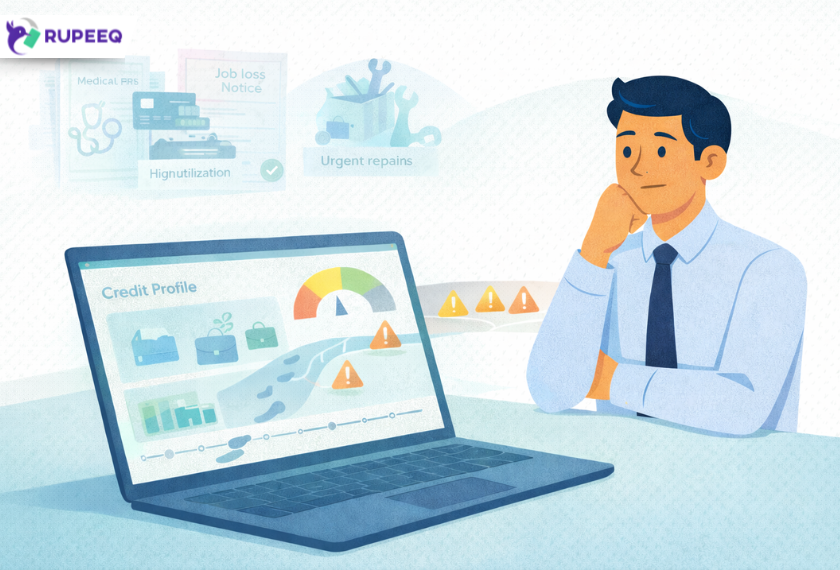
Financial emergencies rarely come with a warning. A medical expense, sudden job loss, urgent home repair, or a family obligation can force people to make quick financial decisions. In such moments, the priority is survival and stability, not long-term planning.
What many borrowers realise only later is that how you manage money during an emergency can leave lasting footprints on your credit profile, even years after the crisis has passed. These effects are not always visible immediately and often surface when you apply for an important loan later in life.
In this blog, we will explain how financial emergencies impact credit health, the common credit decisions people make under pressure, how those decisions shape long-term credit behaviour, and what you can do to minimise damage if you ever face a similar situation again.
Why Emergencies Affect Credit More Than Normal Expenses
Unlike planned expenses, emergencies force quick decisions.
During emergencies:
- Savings may be insufficient
- Income may be disrupted
- Borrowing becomes reactive
- Repayment planning is secondary
This combination increases the likelihood of credit stress, which credit bureaus and lenders track closely.
RupeeQ Tip:
Credit damage during emergencies usually comes from rushed decisions, not from the emergency itself.
Common Types of Financial Emergencies
Financial emergencies vary, but their credit impact often follows similar patterns.
Typical Emergency Scenarios
- Medical treatment or hospitalisation
- Sudden job loss or pay cuts
- Family obligations or dependents
- Business cash flow disruptions
- Major home or vehicle repairs
Each situation pushes borrowers towards short-term credit solutions that may not be optimal for long-term credit health.
Emergency Decision 1: Taking Multiple Short-Term Loans
One of the most common responses to emergencies is stacking small loans.
Example:
| Loan Type | Amount | EMI |
| Personal Loan | ₹1,00,000 | ₹3,200 |
| Credit Card EMI | ₹50,000 | ₹2,000 |
| App-based Loan | ₹30,000 | ₹1,200 |
| Total EMI | – | ₹6,400 |
Individually, each loan seems manageable. Together, they increase:
- EMI burden
- Unsecured credit exposure
- Default risk
Lenders later interpret this pattern as financial fragility, even if all EMIs were paid on time.
Emergency Decision 2: Delayed or Missed Payments
During emergencies, repayments often take a back seat.
Common Behaviours
- Paying minimum dues only
- Missing EMIs temporarily
- Skipping one account to pay another
Even a single missed payment can:
- Trigger a sharp credit score drop
- Stay on record for years
- Slow recovery significantly
Why the Impact Is Long-Term
Credit scoring systems give high weight to recent distress signals. A 30+ DPD event during an emergency continues to influence lender perception long after the crisis ends.
Emergency Decision 3: High Credit Card Utilisation
Credit cards are often the first line of defence in emergencies.
What Happens
- Limits are maxed out quickly
- Utilisation rises above 70–80 percent
- Available credit shrinks
Credit Impact
- High utilisation signals cash flow stress
- Credit profile weakens even if payments are on time
- Score improvement slows significantly
Many borrowers clear balances later but are surprised when their credit score does not bounce back quickly.
RupeeQ Tip:
Credit utilisation needs to stay low consistently across months, not just temporarily, for credit recovery.
Emergency Decision 4: Loan Settlements or Restructuring
When emergencies stretch finances too far, some borrowers opt for:
- Loan settlement
- Restructuring
- Partial closures
While these options offer short-term relief, they leave permanent markers in the credit history.
How Lenders View Settlements
- Indicates inability to meet original commitment
- Raises future default probability
- Weakens trust, even if score later improves
This footprint often resurfaces during home loan or business loan evaluation.
Emergency Decision 5: Frequent Credit Applications
Under pressure, borrowers may apply to multiple lenders hoping one will approve quickly.
Resulting Pattern
- Multiple enquiries in short time
- Rejections followed by new applications
- Credit hunger signal
Even if credit score remains acceptable, lenders later view this behaviour as reactive borrowing, not planned credit usage.
Why Emergency Credit Footprints Last Longer Than Expected
The impact of emergency-driven credit decisions is not always immediate.
Long-Term Effects Include
- Higher interest rates on future loans
- Reduced loan eligibility
- Stricter documentation requirements
- Preference for secured over unsecured credit
Credit reports do not record why an issue happened, only that it happened.
Example: Same Score, Different Credit History
| Borrower A | Borrower B |
| Faced emergency, missed EMIs | No emergency borrowing |
| Settled one loan | Clean closures |
| Credit score: 720 | Credit score: 720 |
| Lower loan eligibility | Higher loan eligibility |
This difference highlights why credit history quality matters alongside credit score.
How Financial Emergencies Shape Credit Behaviour Patterns
Lenders do not just look at isolated events. They look for patterns such as:
- Repeated emergency borrowing
- Dependence on short-term credit
- Weak savings buffer
- Rising unsecured exposure
These patterns influence long-term credit confidence more than one-time incidents.
How to Reduce Credit Damage During Emergencies
Emergencies cannot always be avoided, but credit damage can be limited.
Step 1: Prioritise Timely Payments
Even if you cannot pay everything:
- Pay minimum dues
- Avoid crossing 30+ DPD
- Communicate early with lenders
Step 2: Avoid Stacking Too Many Loans
Choose:
- One structured loan over many small ones
- Predictable EMI over fragmented repayments
Step 3: Control Credit Card Usage
- Avoid maxing out cards
- Spread expenses across available limits
- Start reducing utilisation as early as possible
Step 4: Avoid Settlements Unless Absolutely Necessary
Settlements should be:
- Last resort
- Fully understood for long-term impact
- Taken only after exploring restructuring options
RupeeQ Tip:
Short-term relief decisions often cost more in long-term credit health than borrowers expect.
Rebuilding Credit After an Emergency
Credit recovery after an emergency requires patience and consistency.
What Helps Most
- On-time payments for 6–12 months
- Gradual reduction in utilisation
- Fewer new credit applications
- Stable income patterns
Credit footprints fade slowly, but disciplined behaviour reduces their influence over time.
How RupeeQ Helps You Understand Emergency Credit Impact
RupeeQ helps borrowers understand why their credit profile looks the way it does after an emergency.
By analysing:
- Emergency-driven borrowing patterns
- EMI stress indicators
- Utilisation behaviour
- Credit history markers
RupeeQ provides clarity on:
- What is holding eligibility back
- What can be corrected now
- How long recovery may realistically take
Key Takeaways
- Financial emergencies often force reactive credit decisions
- Small emergency choices leave long-term credit footprints
- Missed payments and settlements have lasting impact
- Credit score alone does not show emergency stress history
- Planned recovery restores credit confidence over time
Frequently Asked Questions (FAQs)
1. Do emergencies permanently damage credit?
No, but they can leave long-lasting markers that take time to fade.
2. Is one missed payment during an emergency very harmful?
Yes. Even a single 30+ DPD can affect credit perception for months.
3. Does restructuring hurt credit less than settlement?
Generally, yes. Settlements have stronger negative impact.
4. How long does credit recovery take after an emergency?
Typically 6 to 18 months, depending on severity.
5. Can lenders see that an issue was due to an emergency?
No. Credit reports do not record context, only behaviour.