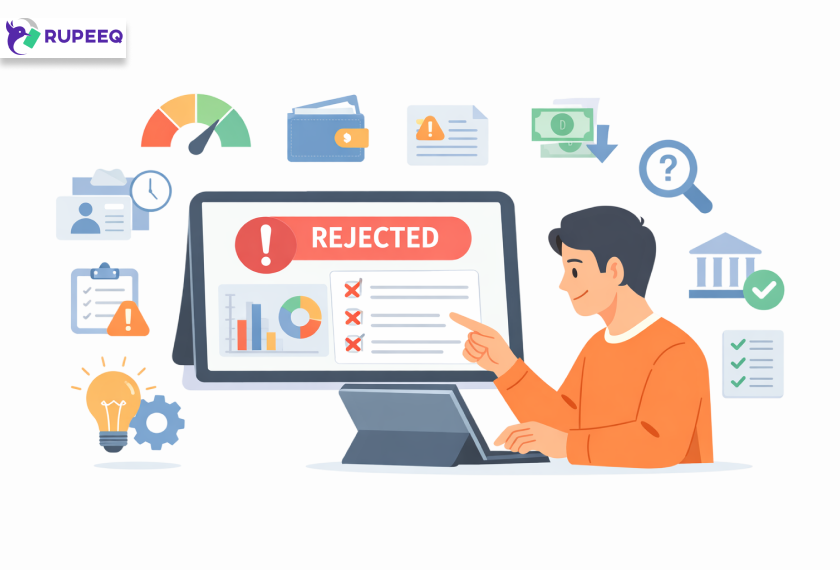
You’ve got the salary, the documents, and a decent credit score. The application takes less than ten minutes. Then comes the message you didn’t expect: your loan has been rejected.
It feels confusing, especially when nothing seems obviously wrong. But lenders don’t reject applications on instinct. They rely on specific risk checks, and even one weak signal in your profile can be enough to tip the decision. According to the Federal Reserve, around 20% of credit applications in the U.S. are denied, most often due to issues tied to credit history and existing debt.
The tricky part is that these patterns are predictable once you know where to look. The most common personal loan rejection reasons show up again and again across lenders, whether it’s a high debt load, too many recent applications, or gaps in your credit history.
In this guide, you’ll see exactly what lenders pay attention to and what you can do to fix it before you apply again.
What Do Lenders Check Before Approving a Personal Loan?
Before you get into specific personal loan rejection reasons, it helps to understand how lenders look at your application in the first place. Most decisions come down to a few core checks that quickly tell them how risky it is to lend to you.
Credit score and repayment history: Checking the credit score is usually the first filter. A strong score shows you’ve handled credit responsibly over time. Lenders also look beyond the number into your report. Missed payments, settlements, or defaults carry more weight than you might expect.
Income and job stability: It’s not just about how much you earn. Lenders want to see consistency. Salaried applicants with stable employment often get preference, while frequent job changes or irregular income can raise concerns about repayment.
Existing debt obligations: If a large portion of your income is already going toward EMIs or credit card bills, lenders see less room for another loan. This is where your debt-to-income ratio becomes important.
Recent credit activity: Applying for multiple loans or credit cards within a short span can work against you. It signals urgency for credit, which lenders tend to treat as a risk factor.
Basic eligibility and documentation: Age, location, employer category, and complete documentation all play a role. Even small inconsistencies between what you declare and what your documents show can affect the outcome.
Each of these factors connects directly to common personal loan rejection reasons. Once you understand how lenders evaluate risk, the reasons behind a rejection become much easier to identify and fix.
Common Personal Loan Rejection Reasons
1. Low Credit Score
A low credit score is one of the most frequent personal loan rejection reasons because it directly reflects how you’ve handled credit in the past. Lenders don’t just look at the number. They examine patterns like late payments, credit utilization, and the length of your credit history. A score below 650 is often seen as high risk, while anything above 700 is generally safer territory.
How to fix it:
Focus on consistent, on-time payments across all credit accounts. Bring down your credit card balances instead of revolving high utilization month after month. Avoid closing old credit accounts, as they add to your credit history length. Improving your score takes time, but even a 50–70 point increase can change the outcome of your next application.
2. High Debt-to-Income Ratio (DTI)
Your income might look strong on paper, but lenders care about how much of it is already committed. If a large chunk goes toward EMIs, credit cards, or other obligations, it limits your repayment capacity. This is one of those personal loan rejection reasons that catches many applicants off guard because it’s not always visible at first glance.
How to fix it:
Maintaining a healthy debt-to-income ratio makes it easier to get approved by loan providers. Start by paying down high-interest debts, especially credit cards. If you have multiple loans, consider consolidating them into a single lower-interest option. You can also improve your chances by applying for a smaller loan amount or choosing a longer tenure to reduce your monthly burden.
3. Unstable Employment or Income
Lenders prefer predictability. If your employment history shows frequent job changes, short stints, or inconsistent income, it raises concerns about your ability to maintain steady repayments. For self-employed individuals, fluctuating income can trigger similar concerns and become one of the key personal loan rejection reasons.
How to fix it:
Try to maintain at least 6–12 months of stability in your current role before applying. If you’re self-employed, keep clean financial records, maintain steady bank inflows, and ensure your income tax returns accurately reflect your earnings. Documentation plays a big role in building lender confidence here.
4. Multiple Loan Applications in a Short Time
Every time you apply for credit, lenders perform a hard inquiry on your report. A cluster of these inquiries within a short period signals urgency or financial stress. This pattern is one of the less obvious personal loan rejection reasons, but it can quietly lower your approval chances.
How to fix it:
Be selective about where you apply. Check eligibility criteria in advance and avoid applying to multiple lenders at once. If available, use pre-approved or pre-qualified offers, as they often involve softer checks and carry a higher likelihood of approval.
5. Poor Credit History or Defaults
A history of missed EMIs, defaults, or settled accounts is a major red flag. Unlike a slightly low score, this shows actual repayment issues. Among all personal loan rejection reasons, this one carries the most weight because it directly impacts lender trust.
How to fix it:
Clear any outstanding dues as soon as possible. Avoid settling loans unless absolutely necessary, since it reflects negatively on your report. Once cleared, rebuild your profile with smaller credit products and maintain a clean repayment record over time.
6. Errors in Your Credit Report
Not all personal loan rejection reasons are within your control. Credit reports can sometimes contain incorrect information such as duplicate accounts, wrong payment statuses, or loans you never took. These errors can bring down your score and affect your application.
How to fix it:
Review your credit report in detail before applying. If you find discrepancies, raise a dispute with the credit bureau and provide supporting documents. Corrections can take a few weeks, but they can significantly improve your approval chances.
7. Insufficient Income
Each lender has a minimum income threshold based on the city you live in and the loan amount you request. Falling short of this benchmark is one of the more straightforward personal loan rejection reasons, but it’s often overlooked.
How to fix it:
Apply for a loan amount that aligns with your income level. You can also explore lenders with lower eligibility thresholds or add a co-applicant with a stable income to strengthen your profile.
8. Employer or Job Profile Not Eligible
Some lenders categorize employers and industries based on perceived risk. If you work in a sector they consider unstable or if your employer isn’t on their preferred list, your application may be declined. This is one of those personal loan rejection reasons that varies widely between lenders.
How to fix it:
Research lenders that are more flexible with employer categories. If possible, provide additional proof of income stability, such as consistent salary credits or long-term employment records.
9. Age Does Not Meet Criteria
Lenders set age limits to ensure the loan tenure fits within your earning years. Applicants who are too young or nearing retirement may face rejection. While this may seem rigid, it remains one of the standard personal loan rejection reasons across institutions.
How to fix it:
Choose a loan tenure that fits within the acceptable age range. If needed, apply with a co-applicant who meets the criteria to improve eligibility.
10. Incomplete or Incorrect Documentation
Even a strong profile can get rejected due to documentation issues. Missing income proof, mismatched signatures, or incorrect personal details can delay verification or lead to outright rejection. This is one of the most avoidable personal loan rejection reasons.
How to fix it:
Double-check every document before submission. Ensure consistency across your ID proof, income records, and application form. Small errors can create unnecessary friction, so accuracy matters.
Conclusion
A rejected application can feel like a setback, but it usually comes down to a few identifiable issues rather than a single major flaw. The most common personal loan rejection reasons tend to revolve around credit behavior, income stability, and how you manage existing debt. Once you understand what lenders are actually evaluating, the decision starts to make a lot more sense.
What matters is how you respond next. Instead of reapplying immediately, take the time to review your credit profile, fix gaps, and strengthen your overall financial position. Even small improvements, like reducing your credit utilization or correcting an error on your report, can significantly improve your chances.
A more informed approach doesn’t just help you get approved. It also puts you in a position to secure better terms when you do.
FAQs
1. What are the most common personal loan rejection reasons?
The most common personal loan rejection reasons include a low credit score, high debt-to-income ratio, unstable income, multiple recent credit applications, and poor repayment history. Documentation issues and credit report errors can also lead to rejection.
2. Can I apply again after my personal loan is rejected?
Yes, but applying again immediately is not advisable. It’s better to first identify the exact personal loan rejection reasons, fix the issues, and then reapply after a gap of a few weeks or months.
3. How long should I wait before reapplying for a personal loan?
Ideally, you should wait at least 30 to 90 days before reapplying. This gives you enough time to address the personal loan rejection reasons, improve your credit profile, and avoid multiple hard inquiries.
4. Does a personal loan rejection affect my credit score?
The rejection itself does not impact your score, but the hard inquiry made during the application can cause a small dip. Multiple applications in a short time can amplify this effect and become one of the personal loan rejection reasons later.
5. How can I improve my chances of personal loan approval quickly?
Start by paying all dues on time, reducing existing debt, and checking your credit report for errors. Applying with the right lender, choosing a realistic loan amount, and addressing key personal loan rejection reasons can improve your approval chances significantly.