A good credit score is often seen as a green signal for loan approval. Many borrowers believe that once they cross the 700 or 750 mark, getting a loan becomes a certainty. However, in reality, a good credit score improves your chances but does not guarantee approval.
This is where most people feel confused or even frustrated. “My credit score is strong, so why was my loan rejected?” The answer lies in how lenders actually evaluate loan applications. Credit score is important—but it is only one part of a much bigger evaluation framework.
In this blog, we will explain why a good credit score alone may still not be enough, what lenders look at beyond the score, and how you can strengthen your overall loan eligibility.
What Is Considered a “Good” Credit Score?
Before going further, let’s define what “good” means in lending terms.
Typical Credit Score Ranges
| Credit Score Range | Meaning |
| Below 600 | Weak |
| 600 – 680 | Average |
| 680 – 740 | Good |
| 740+ | Very Good to Excellent |
A score above 680 generally qualifies you for most loan products. But qualification does not equal approval.
RupeeQ Tip:
A good credit score opens the door—but lenders still decide whether to let you walk through it.
Reason 1: Your Income Is Not Enough for the Loan Amount
One of the most common reasons for rejection—even with a good credit score—is insufficient income.
Lenders assess whether your income can comfortably support:
- The EMI
- Your existing financial obligations
- Your living expenses
Example:
- Credit Score: 740
- Monthly Income: ₹25,000
- Loan Applied: ₹5 lakh personal loan
Even with a strong score, the EMI may be too high compared to income, leading to rejection.
What Lenders Check:
- Monthly income
- Income consistency
- Salary credits or business inflows
- Sustainability of repayments
RupeeQ Tip:
Always align the loan amount with your income capacity, not just your credit score strength.
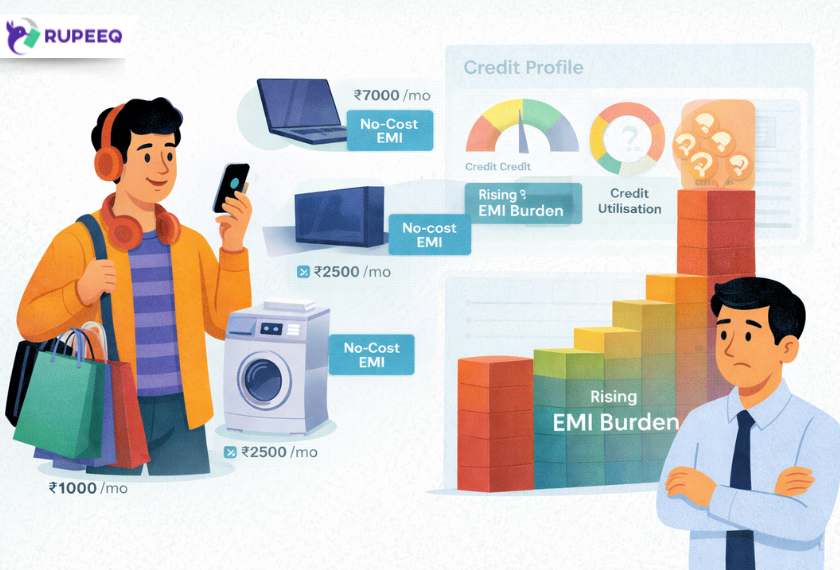
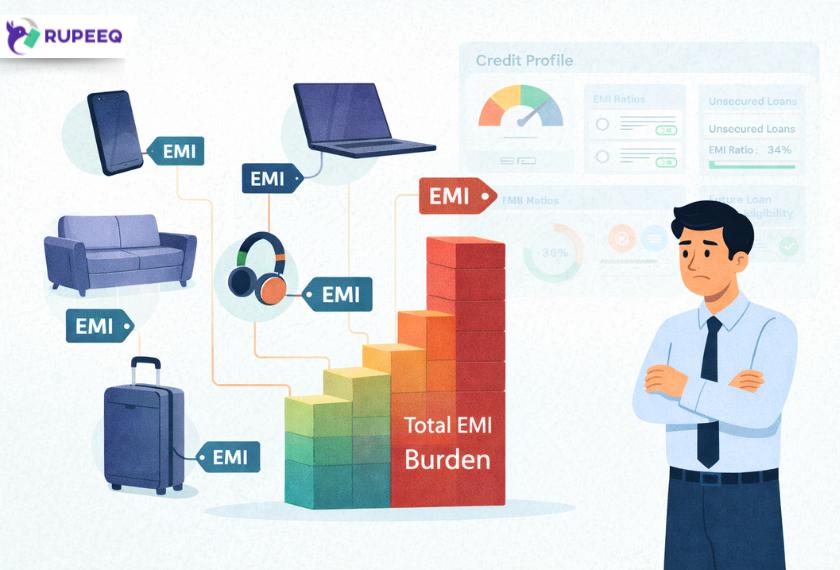
Reason 2: High Existing EMI Burden
Your credit score does not fully reflect how stretched your finances currently are.
EMI-to-Income Ratio Matters
Most lenders prefer that your total EMIs do not exceed:
- 40–50% of your monthly income
Example:
| Details | Amount |
| Monthly Income | ₹70,000 |
| Existing EMIs | ₹35,000 |
| Credit Score | 760 |
Despite an excellent score, lenders may reject or reduce the loan amount due to high repayment pressure.
Why This Matters:
A high EMI burden increases default risk—even for disciplined borrowers.
Reason 3: Too Many Recent Loan or Credit Card Applications
You may have a good credit score today, but recent behaviour matters more than past history.
Multiple Credit Enquiries Signal Risk
- Applying to several lenders in a short period
- Frequent credit card or loan applications
- Rejections followed by new applications
Example:
| Last 60 Days | Status |
| Loan Enquiries | 6 |
| Credit Score | 730 |
Lenders may see this as:
- Credit hunger
- Financial stress
- Emergency borrowing behaviour
RupeeQ Tip:
Avoid trial-and-error applications. A targeted approach improves approval chances and protects your credit profile.
Reason 4: Unstable Employment or Income Pattern
Lenders don’t just check how much you earn—they check how reliably you earn it.
Employment Stability Plays a Key Role
- Frequent job changes
- Short tenure in current job
- Irregular income cycles (for self-employed)
Example:
| Borrower | Credit Score | Job Tenure |
| A | 750 | 5 years |
| B | 750 | 3 months |
Borrower B is considered riskier, even with the same score.
Reason 5: Nature of Credit History Matters More Than Score
Two borrowers may have the same credit score, but very different credit histories.
Risky Credit Patterns Include:
- Past settlements
- Restructured loans
- Write-offs (even if old)
- High reliance on unsecured loans
These details may not drastically lower your score—but lenders still see them.
Important Insight:
A “clean” credit history often matters more than just a high number.
Reason 6: High Credit Utilisation Despite Good Score
Some borrowers maintain a good score but continuously use most of their available credit.
Example:
- Credit Card Limit: ₹2,00,000
- Utilisation: ₹1,60,000 (80%)
- Credit Score: 720
This indicates:
- Cash-flow dependency
- Limited financial buffer
Lenders may hesitate even if repayments are on time.
RupeeQ Tip:
Lower utilisation improves how lenders interpret your creditworthiness—not just your score.
Reason 7: Loan Type vs Borrower Profile Mismatch
Not every loan suits every borrower—even with a good score.
Examples:
- Short job tenure + long-tenure loan
- Irregular income + high EMI product
- High unsecured exposure + new personal loan
Lenders assess fitment, not just eligibility.
Reason 8: Lender-Specific Risk Rules
Each bank or NBFC follows its own internal risk framework.
What one lender rejects:
- Another may approve
- With different terms
- Or a different loan structure
This is why the same borrower can see:
- Rejection from one lender
- Approval from another
Why Credit Score Alone Is Not Enough
Here’s a simplified comparison:
| Parameter | Credit Score Shows | Lenders Also Need |
| Repayment history | ✔ | ✔ |
| Current income | ✖ | ✔ |
| EMI stress | ✖ | ✔ |
| Job stability | ✖ | ✔ |
| Credit behaviour | Partial | ✔ |
A good credit score strengthens your profile—but loan approval is always holistic.
How RupeeQ Helps You Move Beyond Just a Credit Score
RupeeQ evaluates your complete credit profile, not just the score.
By assessing:
- Active loans
- EMI stress
- Income fitment
- Credit behaviour patterns
RupeeQ helps identify:
- Why approvals may fail
- Which loan type suits you better
- What corrective actions improve eligibility
This reduces rejections and protects your credit health.
Key Takeaways
- A good credit score is necessary—but not sufficient
- Income and EMI capacity matter heavily
- Recent credit behaviour impacts approvals
- Lenders assess risk, not just numbers
- Profile-based matching improves outcomes
Frequently Asked Questions (FAQs)
1. Can a loan be rejected even with a 750+ credit score?
Yes. High EMIs, low income, unstable employment, or recent enquiries can still cause rejection.
2. Does income matter more than credit score?
Both matter. Credit score shows intent; income shows ability.
3. Why do banks reject loans without clear reasons?
Banks use internal risk models that are not fully disclosed to borrowers.
4. Will checking loan eligibility reduce my credit score?
Exploring suitable options carefully avoids unnecessary credit enquiries.
5. How can I improve approval chances without improving my credit score?
Lower EMIs, reduce utilisation, stabilise income, and avoid frequent applications.