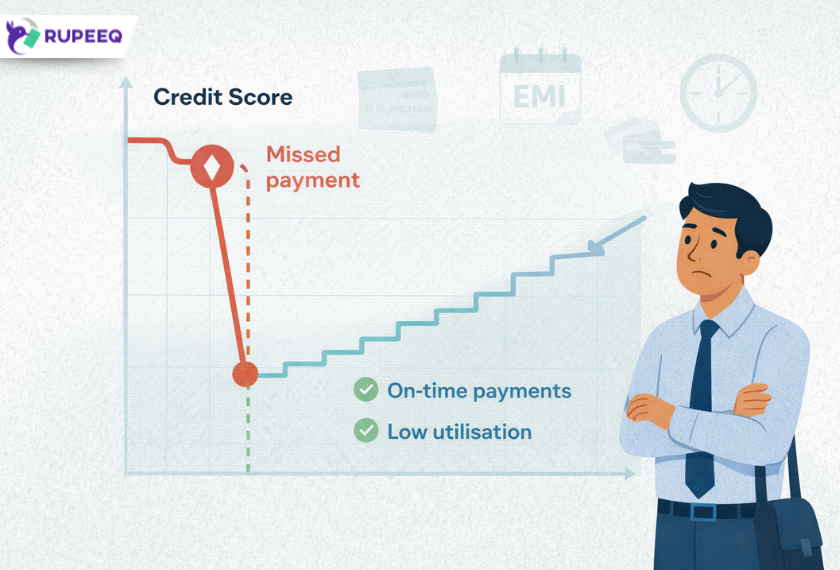
Many borrowers experience this frustrating pattern: one missed payment and the credit score drops sharply, but months of disciplined repayments barely move it upward. This often leads to a common question: why does my credit score fall so fast but take so long to recover?
The short answer is this: credit scoring systems are designed to punish risk quickly but reward discipline slowly. This may feel unfair, but it is intentional. Lenders want early warning signals of risk and long-term proof of reliability.
In this blog, we will explain why credit scores drop faster than they improve, how lenders interpret your credit behaviour, and most importantly, what practical steps you can take to fix and rebuild your credit score effectively.
How Credit Scores Are Designed to Work
Credit scores are not just mathematical totals. They are risk prediction tools built to answer one core question:
How likely is this borrower to default in the future?
To answer this, credit bureaus and lenders focus more on recent negative behaviour than old positive behaviour.
Why This Matters
A single mistake can signal financial stress
Consistent discipline over time proves stability
Risk detection is prioritised over reward
This is why recovery is slower than decline.
Reason 1: Negative Events Carry More Weight Than Positive Ones
Credit scoring models are loss-averse by design. This means they react strongly to negative signals.
Examples of High-Impact Negative Events
Missed EMI or credit card payment
30+ DPD (Days Past Due)
Loan settlement or restructuring
Credit card over-limit usage
Even one missed payment can undo months of good behaviour.
Why Positive Behaviour Takes Longer
Paying EMIs on time is expected, not exceptional
Positive behaviour must be repeated consistently
Lenders want long-term patterns, not short-term fixes
RupeeQ Tip:
Think of credit repair as reputation rebuilding. One mistake damages trust quickly, but rebuilding trust takes time and consistency.
Reason 2: Recency Bias in Credit Scoring
Credit scores are time-sensitive.
What you did recently matters more than what you did years ago.
How Time Impacts Credit Score
Missed payment last month → high impact
Missed payment 2 years ago → lower impact
On-time payments over 12–18 months → gradual improvement
This explains why:
Scores fall immediately after a default
Scores recover only after sustained discipline
Example Timeline
Event
Credit Score Impact
Missed EMI
Immediate drop
3 months on-time
Minor recovery
6 months on-time
Moderate recovery
12+ months
Strong improvement
Reason 3: Credit Utilisation Corrects Slowly
Credit utilisation (how much credit you use vs what you have) is one of the most misunderstood factors.
Example:
Credit Card Limit: ₹1,00,000
Utilisation:
₹90,000 → Score drops quickly
₹30,000 → Score improves gradually
Why the Recovery Is Slow
High utilisation signals dependency
Reducing balances must be sustained
Temporary reduction doesn’t reset risk perception
RupeeQ Tip:
Lower utilisation consistently across billing cycles—not just once—to see real improvement.
Reason 4: Settlements and Past Defaults Take Time to Fade
Even after you clear dues, the history remains.
Common Misconception
“Once I paid everything, my score should bounce back immediately.”
Reality
Settlements remain visible
Late payments stay on record
Scoring impact reduces slowly over time
Why This Happens
Lenders care about patterns, not one-time corrections.
A settled loan suggests:
Financial stress at some point
Compromised repayment ability
Higher future risk than a clean closure
Reason 5: Credit Mix and Profile Depth Take Time to Build
A credit score also depends on how mature your credit profile is.
Thin Credit Profile Issues
Only one loan or card
Short credit history
Limited repayment data
Even with perfect behaviour, improvement is gradual because:
There’s less data to analyse
Risk prediction confidence is lower
Thick Credit Profile Advantages
Multiple loans/cards
Long repayment history
Diverse credit mix
This is why seasoned borrowers recover faster than new borrowers.
Why Credit Score Drops Feel Sudden (But Aren’t Random)
A score drop often feels sudden, but it usually reflects accumulated stress signals, such as:
Gradually rising utilisation
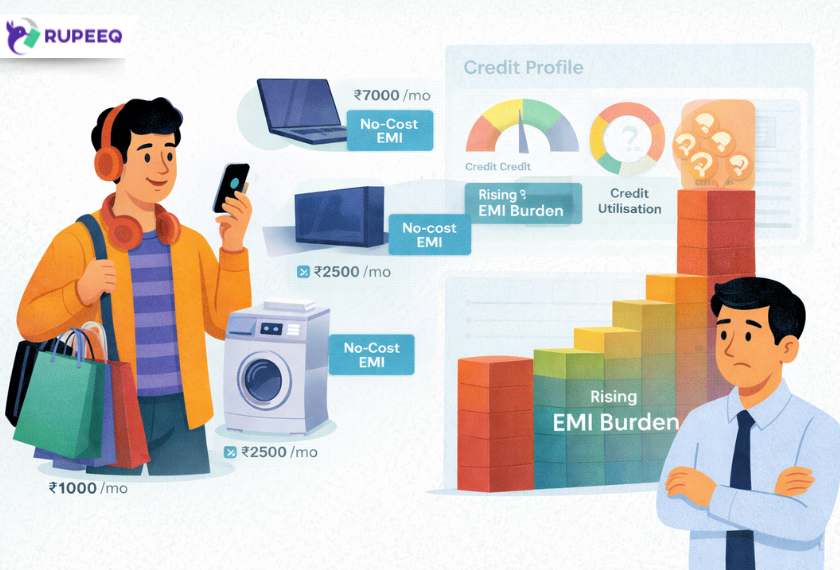
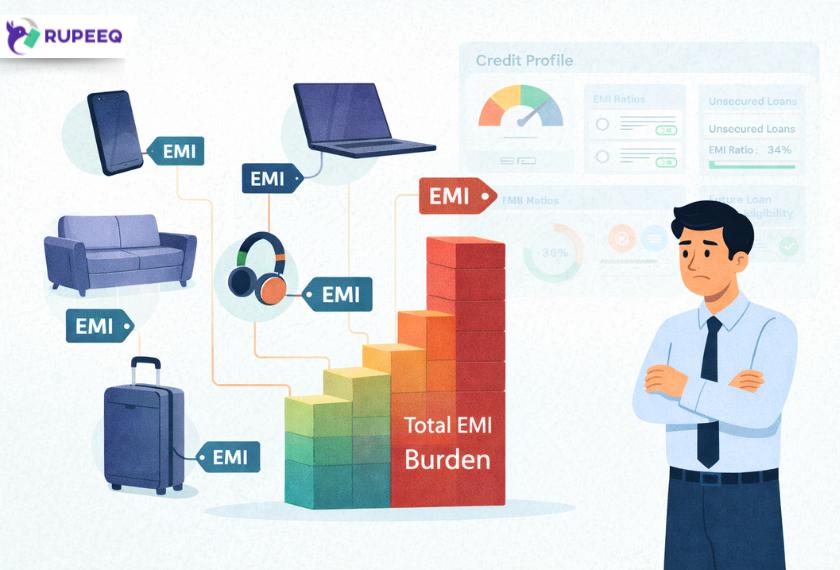
Increasing EMI burden
Multiple recent enquiries
Minor delays adding up
The drop happens when risk crosses a threshold.
How to Fix Slow Credit Score Recovery (Practical Steps)
Improving your credit score requires strategy, not shortcuts.
Step 1: Eliminate Missed Payments Completely
This is non-negotiable.
Set auto-debit reminders
Maintain buffer balance
Pay at least minimum due on credit cards
Even one missed payment can stall recovery for months.
Step 2: Reduce Credit Utilisation Systematically
Target utilisation:
Below 30% is ideal
Below 40% is acceptable
Example Plan:
Month 1: Reduce from 80% to 60%
Month 2: Reduce to 45%
Month 3: Reduce to 30%
Gradual reduction signals control and stability.
Step 3: Avoid Fresh Credit Applications During Recovery
Every new enquiry:
Slows recovery
Signals credit hunger
Adds uncertainty
RupeeQ Tip:
Pause new applications until your credit behaviour stabilises. Recovery is faster without fresh risk signals.
Step 4: Keep Old Credit Accounts Active
Closing old accounts reduces:
Credit history length
Available credit
Stability indicators
Instead:
Keep old cards active with small spends
Pay dues fully every cycle
Step 5: Focus on EMI Discipline Over Loan Closure
Many borrowers rush to close loans. While closure helps, repayment discipline matters more.
A closed loan removes ongoing positive signals.
Balanced approach:
Close high-interest debt
Maintain at least one active, well-managed account
How RupeeQ Helps You Understand Slow Credit Recovery
RupeeQ helps decode why your credit score is stuck, even when you feel you are doing everything right.
By analysing:
Active accounts
Utilisation patterns
Repayment consistency
Enquiry behaviour
RupeeQ provides actionable insights—not generic advice—so you know exactly what is holding your score back and how to fix it responsibly.
Key Takeaways
Credit scores fall fast due to risk sensitivity
Improvement requires sustained discipline
One-time fixes don’t work
Behaviour consistency matters more than intent
Smart planning accelerates recovery
Frequently Asked Questions (FAQs)
1. How long does it take to recover a dropped credit score?
Typically 6–12 months of disciplined behaviour, depending on the severity of past issues.
2. Can paying dues immediately restore my score?
No. Payment stops further damage, but recovery takes time.
3. Does checking my credit score slow recovery?
Checking your own score does not impact it.
4. Why is my score not improving despite timely payments?
High utilisation, past defaults, or limited credit history may be slowing progress.
5. What is the fastest safe way to improve credit score?
Timely payments, low utilisation, fewer enquiries, and patience.