Three EMIs, two credit card bills, and a rent transfer that leaves your account on the 1st. If that’s your month, you are not bad with money. You are just paying four different lenders at four different interest rates.
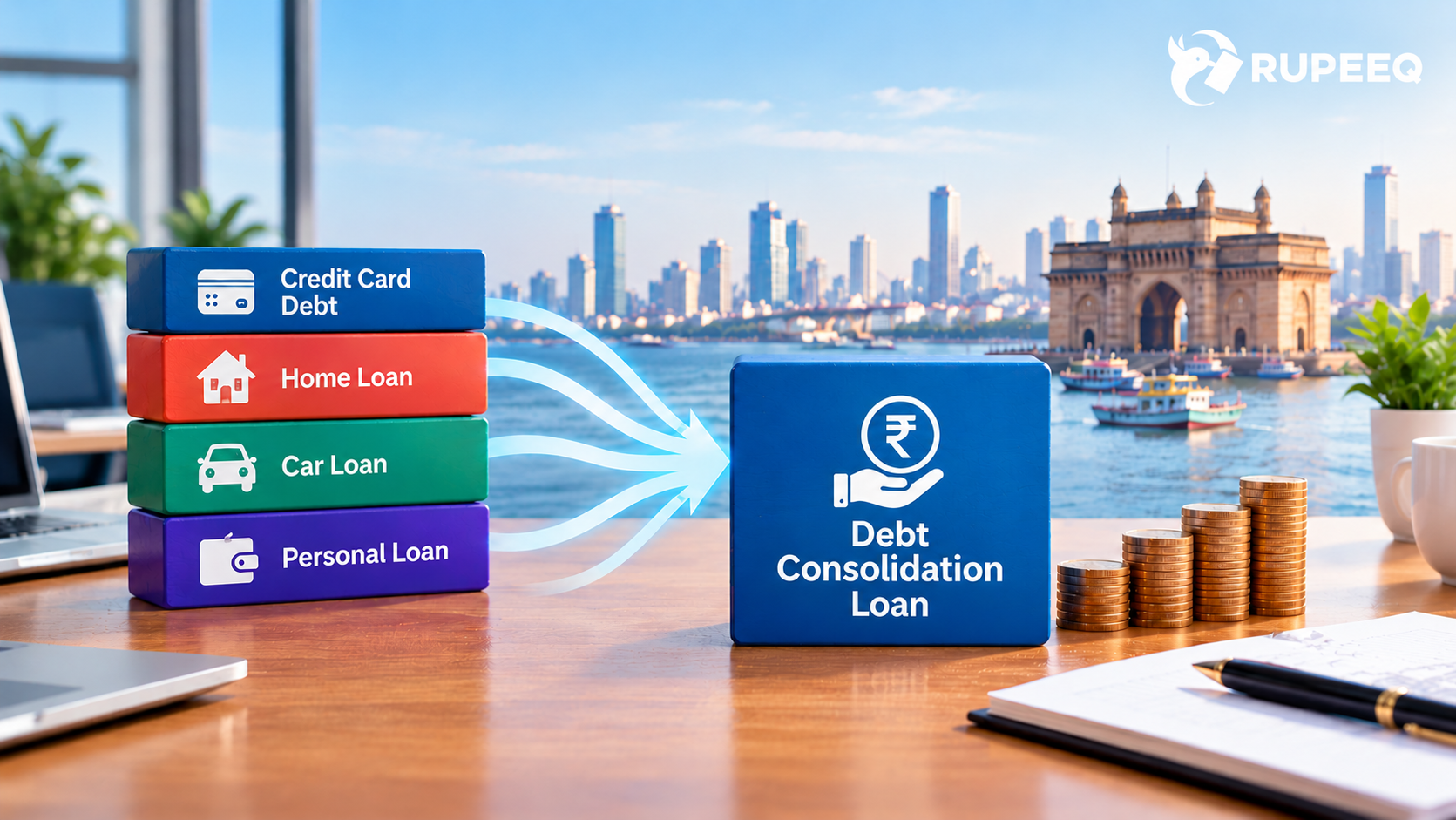
A Debt Consolidation Loan in Mumbai folds all of that into a single EMI. This blog covers how it works in this city specifically, who approves it, and what trips Mumbai borrowers up.
Why Mumbai Borrowers End Up Juggling Multiple EMIs
Debt here rarely comes from one big decision. It stacks up quietly, one convenient EMI at a time.
- A brokerage and deposit payment funded on a credit card
- A consumer durable EMI for an AC or washing machine
- A small personal loan taken during a salary delay
- A no-cost EMI on a phone that never felt like real debt
Nationally, the pattern is visible in the data. Non-mortgage household borrowings in India have climbed to 27% of GDP, with households adding debt faster than incomes are growing.
Repaying one loan by borrowing on another card is one of the clearest debt trap signs in India. It builds slowly, then all at once.
What a Debt Consolidation Loan in Mumbai Actually Does
It is a single loan used to close your existing debts. After that, you repay one lender instead of five.
- All outstanding dues get cleared in one shot
- You move to one fixed EMI and one due date
- The blended rate is usually lower than credit card interest
- Tenure can be stretched to bring the monthly outgo down
- Late payment risk drops because there is only one date to track
There are broadly two main types of consolidation, secured and unsecured. Most salaried borrowers in Mumbai go the unsecured route through a Personal Loan.
RupeeQ Tip: Before you apply, run your numbers through RupeeQ’s free EMI Calculator. Compare your current total EMI outgo against a single consolidated EMI across different tenures. If the new EMI does not save you at least a few thousand a month, the tenure or the rate needs rethinking.
The Mumbai Math: Your Rent Never Shows Up in Your FOIR
This is the part most borrowers in this city miss. Lenders calculate FOIR using your EMIs and card dues. Rent is not an EMI, so it stays invisible to them.
In Mumbai, rent is often the single largest outgo in the month. The result is a borrower who looks comfortable on paper and feels stretched in real life.
Here is an illustrative monthly picture for someone earning ₹70,000 in the city:
| Monthly outgo | Amount | Counted in FOIR? |
| Rent (1BHK, Andheri East) | ₹32,000 | No |
| Personal Loan EMI | ₹8,500 | Yes |
| Credit card minimum due | ₹4,000 | Yes |
| Consumer durable EMI | ₹2,800 | Yes |
| Commute, groceries, utilities | ₹12,000 | No |
On paper, the FOIR is roughly 22%, comfortably inside the 50% ceiling most lenders use. In reality, barely ₹10,700 is left. That gap is exactly why a Debt Consolidation Loan in Mumbai works better when you pick the EMI your rent can survive, not the maximum the lender offers.
RupeeQ Tip: Add your rent to your EMI total and divide by your salary. Keep that combined number under 65%. If you are above it, clear the smallest EMI first before applying anywhere.
Lenders Offering Debt Consolidation Loans in Mumbai
Mumbai has deep lender coverage, which means you have options across banks and NBFCs. Several NBFCs for debt consolidation loans in India approve faster than banks and ask for lighter documentation.
-
Bajaj Finserv
One of the most widely used NBFCs for consolidation in metro cities. Approval is largely digital, and disbursal is quick for salaried applicants with a clean repayment record. Loan amounts are generous enough to clear multiple card balances in one go. Flexi options let you withdraw and repay as needed.
Key features:
- Fully digital application and KYC
- High sanction limits for salaried profiles
- Flexi loan variant with interest on the amount used
Best for: Salaried borrowers who want speed and a large enough ticket size to close several debts at once.
-
Tata Capital
A strong pick if you want structure and predictability over speed. Tata Capital works well for borrowers with a stable employer and a score above 700. Tenure options are flexible, which helps bring the consolidated EMI down to a manageable number. Documentation is standard and the process is transparent.
Key features:
- Flexible tenure choices
- Clear fee and charge disclosure
- Hybrid term loan options for structured repayment
Best for: Mid-income professionals in Mumbai who want a longer tenure and a steady, predictable EMI.
-
IDFC FIRST Bank
A bank option that suits borrowers who prefer a single relationship for their salary account and loan. Rates tend to be competitive for applicants with strong credit profiles. The bank is comfortable with Mumbai’s corporate salary segment, particularly those at listed employers. Processing is quicker if you already bank with them.
Key features:
- Competitive pricing for high credit scores
- Faster processing for existing customers
- Strong digital servicing after disbursal
Best for: Salaried borrowers with scores above 750 who want the lowest possible rate.
-
InCred
Built for borrowers whose profiles do not fit rigid bank templates. InCred assesses income patterns rather than only salary slips, which helps variable-income earners. Approval timelines are short and the process is built around digital verification. Ticket sizes are moderate but sufficient for most card consolidations.
Key features:
- Flexible income assessment
- Quick digital approvals
- Suited to smaller and mid-size consolidation amounts
Best for: Borrowers with incentives, commissions, or inconsistent monthly credits.
-
L&T Finance
Works well for borrowers outside the premium salary bracket who still need a clean consolidation route. The lender has a strong presence across tier-2 markets and Mumbai’s extended suburbs. Requirements are practical rather than restrictive. Repayment terms are straightforward with no complicated structures.
Key features:
- Accessible eligibility criteria
- Wide reach across suburban Mumbai and Thane
- Simple, fixed repayment structure
Best for: Applicants in Thane, Navi Mumbai, or Mira Road with modest salary levels.
Eligibility for a Debt Consolidation Loan in Mumbai
Requirements shift slightly between lenders, but the core checks stay the same. If you want the full picture before applying, the rules around Personal Loan eligibility in India apply here too.
For Salaried Applicants
- Age between 21 and 58 years
- Net monthly salary from ₹20,000, higher at most private banks
- At least one year in your current job
- Credit score of 700 or above for the better rates
- FOIR under 50% after the new EMI is factored in
For Self-Employed Applicants
- Business vintage of two years or more
- ITR filings for the last two financial years
- Bank statements showing consistent business credits
- GST returns, where applicable
Documents You Will Need
Keep these ready before you start. Missing paperwork is the most common reason applications stall.
- PAN card and Aadhaar
- Mumbai address proof, not older than three months
- Last three months’ salary slips
- Last six months’ bank statements
- Statements of the loans and cards you plan to close
The standard documents required for Personal Loans apply to consolidation as well, with one addition. Lenders want proof of what you currently owe.
How to Apply for a Debt Consolidation Loan in Mumbai
Step 1: List every outstanding debt
Write down each balance, its interest rate, and the EMI. You cannot consolidate what you have not counted.
Step 2: Compare offers in one place
Download the RupeeQ app or visit RupeeQ.com to see matched offers from leading banks and NBFCs. One profile check, multiple options, no scattered applications.
Step 3: Pick the tenure your cash flow can hold
Choosing the best loan tenure for debt consolidation matters more than chasing the lowest EMI. Longer tenure lowers the monthly outgo but raises total interest.
Step 4: Apply and close your old accounts
You can apply for a debt consolidation loan online and complete verification digitally. Once disbursed, clear every old balance immediately and request closure confirmations.
Mistakes Mumbai Borrowers Make
- Keeping the old credit cards active and spending on them again
- Applying to four lenders in one week, which adds four hard inquiries
- Ignoring processing fees and foreclosure charges while comparing offers
- Choosing a seven-year tenure for a debt that could clear in three
There are specific mistakes to avoid while applying for a debt consolidation loan that cost borrowers more than the interest rate ever does. Worth knowing before you apply.
Many borrowers also worry about whether consolidating debt hurts your credit score. The dip is short term. Consistent repayment on a single loan usually improves the score within a few months.
Final Thought
A Debt Consolidation Loan in Mumbai does not reduce what you owe. It reorganizes it into something you can actually manage alongside rent, commute, and the cost of living here.
Get three things right and it works. Pick a lender that fits your income, choose a tenure your rent can absorb, and close every old account the day the money lands.
Compare matched offers on RupeeQ.com and move from four due dates to one.
FAQs
-
What is the minimum salary for a Debt Consolidation Loan in Mumbai?
Most NBFCs start at ₹20,000 net per month. Private banks usually want ₹25,000 or more, especially for Mumbai applicants.
-
Can I consolidate credit card dues and a Personal Loan together?
Yes. A single consolidation loan can clear multiple card balances and existing loan accounts at the same time.
-
Does a Debt Consolidation Loan in Mumbai need collateral?
Not usually. Most salaried borrowers take the unsecured route. Secured options exist if you need a larger amount or a lower rate.
-
How long does approval take?
NBFCs often approve within 24 to 48 hours for complete applications. Banks typically take three to five working days.
-
Will my rent affect my eligibility?
Not directly, since lenders do not count rent in FOIR. It should still shape the EMI you agree to, because it decides what you can actually afford.