Ask ten borrowers what debt consolidation means and you will get ten different answers. Some think it wipes dues. Others think it ruins your credit score for years.
These are the debt consolidation questions RupeeQ answers most on calls every week, with the replies our team actually gives, minus the sales pitch.
Why These Questions Are Coming Up More Often
Indian households are carrying more consumption debt than before, and that is what pushes people toward consolidation.
Non-housing retail loans now account for 58.4% of total household debt, up from about 50% in 2019-20, according to the RBI’s Financial Stability Report (Business Today).
Translation: more credit cards, more personal loans, more EMIs per household. That is exactly the profile consolidation was built for.
The Debt Consolidation Questions RupeeQ Answers Most, One by One
-
Is consolidation worth it, or is it just another loan?
Short answer: It is worth it only if the new loan costs less than what you are paying now.
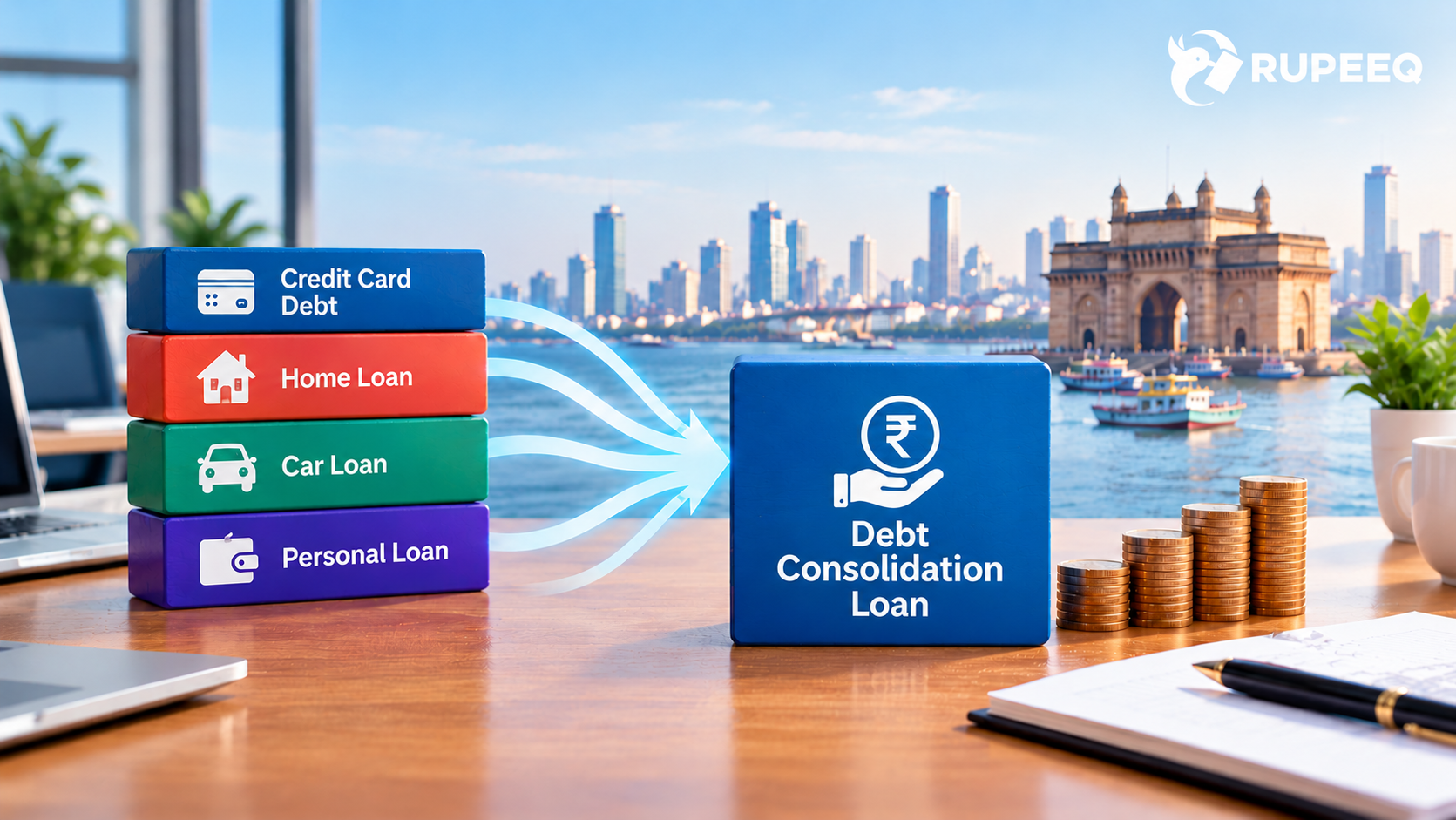
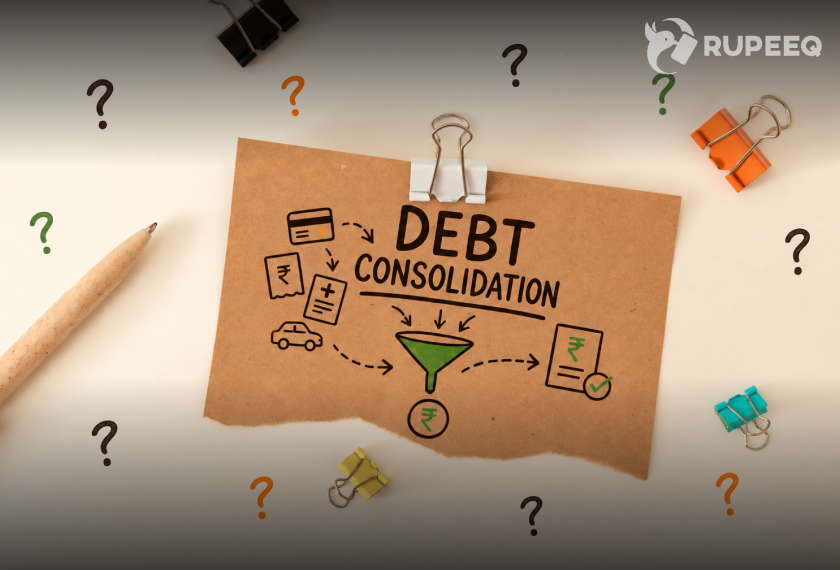
Consolidation does not reduce your debt. It replaces several dues with one loan at a lower blended rate. The benefit shows up in two places: a smaller total interest outgo and one due date instead of five. If the new rate is higher than your current average, you are refinancing for convenience, not savings.
Key points:
- Add up your current EMIs and card interest before comparing any offer
- Factor in processing fees and foreclosure charges on the loans you close
Most relevant if: you are paying three or more lenders and cannot track what you owe overall. This is the honest version of asking whether debt consolidation is good or bad.
-
Is a personal loan the same as a consolidation loan?
Short answer: In India, most consolidation happens through a personal loan.
There is no separate product category at most lenders. You take an unsecured personal loan, use it to clear your existing dues, and run one EMI after that. A few lenders disburse directly to your creditors. Most credit the amount to your account and trust you to close the dues yourself.
Key points:
- Tell the lender the purpose, since some price consolidation cases differently
- Close the old accounts the same week the money lands
Most relevant if: you are comparing a personal loan or debt consolidation and cannot tell the two apart.
RupeeQ Tip: Check your credit score for free on RupeeQ ACE before you shortlist any lender. Your score decides the rate you are offered, and a 40-point gap can change your entire repayment math.
-
Will consolidating hurt my credit score?
Short answer: It dips first, then usually recovers within a few months.
The new loan application creates a hard inquiry, and your average account age drops. That is the dip. What follows matters more. Clearing revolving card dues pulls your credit utilization down sharply, and utilization carries real weight in scoring models.
Key points:
- Keep the paid-off credit cards open, with low usage, to protect your utilization ratio
- Never miss the first three EMIs on the new loan, since early defaults hurt most
Most relevant if: you are holding off because you believe consolidating debt hurts your credit score permanently.
-
What interest rate should I expect?
Short answer: Lower than your credit card dues, higher than a secured loan.
Your rate depends on your credit score, income stability, employer category, and tenure. Revolving credit card balances almost always sit at the top of your interest stack, which is why clearing them saves the most. Two lenders can quote very different rates on the same profile, so one quote is never enough.
Key points:
- Ask for the annual percentage rate, not just the headline interest rate
- Compare the total interest payable, not the EMI alone
Most relevant if: you want to know what the interest rate on a consolidation loan should look like for your profile.
RupeeQ Tip: Before you apply, request a foreclosure statement for every existing loan and the latest outstanding figure on each card. Lenders sanction against the exact number, and guesswork leaves you short by a few thousand rupees.
-
How long should the tenure be?
Short answer: The shortest tenure your monthly budget can absorb comfortably.
A longer tenure lowers your EMI and raises your total interest. A shorter one does the opposite. The practical test is your FOIR, which most lenders want under 50% of your monthly income. Pick the tenure that keeps you inside that line with some breathing room.
Key points:
- Stretching tenure to cut the EMI can erase the saving you borrowed for
- Check whether part-prepayment is allowed, so you can shorten it later
Most relevant if: you are stuck choosing the best loan tenure for debt consolidation between three and seven years.
-
Should I go to a bank or an NBFC?
Short answer: Banks price better, NBFCs approve wider.
Banks usually offer lower rates but apply stricter income and score filters. NBFCs work with thinner profiles, move faster on documentation, and price that flexibility into the rate. If your score is above 750 and your income is stable, start with banks. If you have been rejected once already, the NBFC route is more realistic.
Key points:
- Existing salary account holders often get the fastest bank approvals
- Digital lenders settle quicker, which matters when dues are already overdue
Most relevant if: your profile sits on the edge and you are weighing NBFCs for debt consolidation loans in India against your bank.
-
Can I combine credit card dues and running EMIs in one loan?
Short answer: Yes, and that mix is the most common case we see.
Credit card outstanding, a consumer durable EMI, and a small personal loan can all be cleared with a single sanction. The lender looks at your total obligations, not the individual products. What they do check is whether the loan amount you asked for actually covers everything you listed.
Key points:
- List every due, including BNPL and card EMI conversions, before you apply
- Apply for the full payoff amount, since topping up later needs a fresh application
Most relevant if: your dues are spread across cards, apps, and lenders with different due dates.
-
What is the actual application process?
Short answer: Four steps, and most of it happens before you touch an application form.
Pull your credit report, total your outstanding dues, check your FOIR, then shortlist lenders whose income criteria you already meet. Only after that should you apply. Most rejections at this stage are avoidable, caused by applying to a lender you were never eligible for.
Key points:
- Keep three months of salary slips and six months of bank statements ready
- Apply through one platform instead of five apps, to avoid stacked hard inquiries
Most relevant if: you want to apply for a debt consolidation loan online without branch visits.
-
Can I consolidate again if it did not work the first time?
Short answer: Technically yes, but lenders read repeat applications as a warning sign.
A second consolidation within a short window tells underwriters that spending continued after the first one. Approval gets harder and pricing gets worse. If you are considering it, the problem is usually cash flow rather than loan structure, and a new loan will not fix that.
Key points:
- A repeat round works better when income has genuinely increased
- Fix the spending leak before the application, not after
Most relevant if: you repeated one of the common mistakes to avoid while applying for a debt consolidation loan the first time around.
-
How do I know I need this and not just better budgeting?
Short answer: When your EMIs cross half your income, budgeting alone stops working.
If you are paying one card with another, missing due dates despite having income, or borrowing before salary credit every month, the structure is the problem. Budgeting fixes overspending. Consolidation fixes an expensive, scattered repayment structure. Many borrowers need both.
Key points:
- Calculate your FOIR first, since it decides whether lenders will even help
- Persistent minimum-due payments on cards are the clearest early signal
Most relevant if: you recognize the usual debt trap signs in your own month.
Which Route Fits Your Situation
Beyond the debt consolidation questions RupeeQ answers most, borrowers want to know which route applies to them. Here is how our team usually maps profiles:
| Your situation | Route that usually fits | What to check first |
| Multiple card dues, score above 700 | Single unsecured personal loan | Processing fee and foreclosure terms |
| Small loans, salary under ₹25,000 | NBFC consolidation loan | Lender’s minimum income rule |
| One large loan at a high rate | Balance transfer, not a fresh loan | Transfer charges against interest saved |
| Score below 650 with active dues | Secured loan or a co-applicant | Pledge terms and combined eligibility |
| Dues manageable, EMI dates clash | Restructure dates with your lender | Whether a new loan is needed at all |
Once you know your route, the next step is picking the lender. If a personal loan is your route, it helps to choose a personal loan for debt consolidation on total cost rather than EMI size.
Compare Offers in One Place
Applying to lenders one by one costs you hard inquiries you did not need.
RupeeQ.com matches you with offers from leading NBFCs and banks based on your actual profile, so you apply where you already qualify.
Download the RupeeQ app to track your matched offers and credit score in one place, and apply when the numbers work for you.
Final Thought
The debt consolidation questions RupeeQ answers most come down to a single test: does the new loan cost less than what you are paying today?
Run your numbers against the ten answers above. If three or more apply to your situation, you are probably a genuine consolidation case rather than a budgeting one.
FAQs
-
Can self-employed borrowers get a debt consolidation loan?
Yes. Lenders assess ITR filings, business vintage, and bank statement credits instead of salary slips. Approval usually needs two years of filed returns and steady monthly banking activity.
-
Do I have to close my credit cards after consolidating?
No. Closing them lowers your available credit and can push utilization up. Keep the cards active with minimal spending, and avoid rebuilding balances on them.
-
Are there prepayment charges on a debt consolidation loan?
Floating rate loans to individuals carry no prepayment penalty under current RBI rules. Fixed rate personal loans may still attract foreclosure charges, so confirm this before signing.
-
Can BNPL and EMI card dues be included in consolidation?
Yes, if they appear in your credit report as active obligations. Share the full outstanding list with the lender so the sanctioned amount covers everything you intend to close.
Disclaimer: Interest rates, processing fees, eligibility criteria, and repayment terms vary by lender, applicant profile, RBI guidelines, and market conditions. This article is for general informational purposes only. Verify the latest terms with the lender before applying.