Most business owners don’t run out of money. They run out of timing.
A bulk order lands, your vendor needs payment in 48 hours, and your receivables won’t clear for another 3 weeks. That gap, right there, is a working capital problem. And how you fill it can either save you money or quietly bleed you.
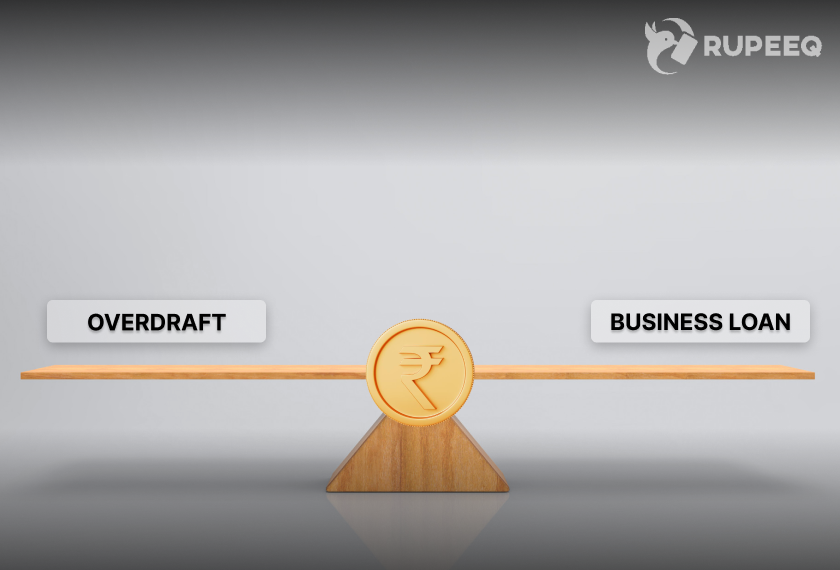
The two most common tools for this are an overdraft facility and a business loan. Both solve a liquidity problem. But they work very differently, and picking the wrong one costs more than most people expect.
Here’s a straight breakdown to help you decide.
What Is a Business Overdraft?
An overdraft is a revolving credit limit linked to your current or savings account. You draw from it when your balance runs low, and you pay interest only on what you actually use, only for the days you use it.
If your overdraft limit is ₹10 lakh and you draw ₹2 lakh for 12 days, you pay interest on ₹2 lakh for 12 days. Nothing more.
Banks and NBFCs typically offer overdraft limits as a multiple of your monthly turnover or average bank balance. The limit stays in place for 12 months and is renewed annually.
Best for:
- Covering short gaps between receivables and payables
- Managing seasonal cash flow dips
- Handling irregular, recurring short-term needs
What Is a Business Loan?
Similar to an instant personal loan, a business loan is a lump-sum amount disbursed upfront. You repay it in fixed monthly installments (EMIs) over a set tenure, regardless of whether you actually needed all the money that month.
Interest is calculated on the full outstanding amount from day one.
Best for:
- Buying equipment or machinery
- Expanding to a new location
- One-time large planned expenses
Overdraft vs Business Loan: Core Differences
| Factor | Overdraft | Business Loan |
| Interest charged on | Amount drawn, daily | Full disbursed amount |
| Repayment structure | Flexible, no fixed EMI | Fixed monthly EMI |
| Disbursal | Revolving limit, available anytime | One-time lump sum |
| Best use case | Short-term liquidity gaps | Planned, large capital needs |
| Renewal | Annual | Fixed tenure, no renewal needed |
| Processing time | Faster for existing account holders | Slightly longer |
| Collateral | Sometimes required | Secured and unsecured options |
When an Overdraft Makes More Sense
-
You Have Irregular Cash Flow
If your business sees 30-day or 60-day payment cycles, an overdraft works like a bridge. You draw when needed, repay when funds arrive, and the cycle continues without a fixed EMI weighing on you every month.
Overall MSME commercial credit exposure increased to ₹35.2 lakh crore as of end-March 2025, according to TransUnion CIBIL’s MSME Pulse Report. That number signals just how aggressively small businesses are using formal credit, and working capital gaps are a primary driver of that demand.
RupeeQ Tip: Before applying for an overdraft, check your free credit score on RupeeQ ACE. A score above 700 puts you in a better position to negotiate higher OD limits and lower interest rates with lenders.
-
The Expense Is Recurring but Unpredictable
Vendor payments, raw material purchases, salary advances in a slow month, these are not one-time events. A business loan locks you into an EMI for 2-5 years for an expense that repeats and varies. An overdraft handles this far more efficiently.
-
You Want to Pay Interest Only on What You Use
This is the single biggest financial advantage of an overdraft. A ₹10 lakh business loan at 14% costs you roughly ₹1.4 lakh in annual interest on the full amount. An overdraft of ₹10 lakh where you only ever draw ₹2-3 lakh costs a fraction of that.
When a Business Loan Makes More Sense
-
You Have a Large, One-Time Capital Requirement
Buying a delivery vehicle, setting up a new production unit, or investing in technology infrastructure, these are expenses where you know the amount upfront and can plan repayment. A business loan is structured for exactly this.
-
You Prefer Predictability in Repayment
Some business owners prefer the discipline of a fixed EMI over the flexibility of an overdraft. If you know you might not repay an OD balance unless forced to, a term loan keeps you accountable. This connects directly to how loan tenure impacts your EMI, something worth calculating before committing to any tenure.
RupeeQ Tip: Use RupeeQ’s free EMI Calculator to run your numbers before picking a loan tenure. Even a 12-month difference in tenure can change your monthly outgo significantly.
-
Your Lender Offers Better Rates on Term Loans
Overdraft interest rates are generally slightly higher than term loan rates because of the flexibility they offer. If the rate difference is significant and your need is a defined amount, a term loan may save more over the full tenure.
The Real Cost Comparison
Here’s a simple example to make this concrete.
Scenario: You need ₹5 lakh for working capital over 6 months.
Business Loan (at 14% p.a., 6-month tenure):
- Interest paid: approximately ₹19,000-21,000
- Fixed EMI every month regardless of cash position
Overdraft (at 16% p.a., drawing ₹5 lakh for 3 out of 6 months):
- Interest paid: approximately ₹12,000
- No EMI pressure in months when you don’t draw
The overdraft wins here, even at a higher interest rate, because you only pay for what you actually use.
Flip the scenario to a full ₹5 lakh used continuously for 6 months, and the overdraft costs more. That is the key variable: utilization.
Common Mistakes Business Owners Make
- Treating an overdraft as permanent capital. OD limits are meant for short gaps. If you are perpetually maxed out on your overdraft for 6-12 months, you likely need a term loan, not a revolving line.
- Taking a business loan for cash flow needs. A 3-year EMI commitment for a seasonal cash crunch creates more pressure than it solves.
- Applying to multiple lenders at once. Each application triggers a hard inquiry on your credit report and can lower your score. It also signals credit stress to lenders. Comparing options on RupeeQ.com lets you check eligibility without multiple hard pulls.
- Not factoring in the FOIR. Whether you choose an overdraft or a business loan, your Fixed Obligation to Income Ratio matters. NBFCs typically want your total EMIs to stay under 50% of your monthly income. This is worth understanding if you are already servicing existing loans, details on how to manage loan EMIs effectively apply here too.
Conclusion: Which One Should You Pick?
Ask yourself two questions:
- Do you know exactly how much you need and when?
- Will you use the full amount continuously or only in short bursts?
If the need is defined and continuous, a business loan gives you structure and often a lower rate. If the need is variable and you want to pay interest only when you draw, an overdraft is the smarter working capital tool.
Most growing businesses eventually use both. A term loan for capital investment. An overdraft for day-to-day cash flow. The mistake is using one for the other’s job.
FAQs
-
Can I have both an overdraft and a business loan at the same time?
Yes, as long as your total debt obligation stays within acceptable FOIR limits. Most lenders allow both as long as you demonstrate repayment capacity.
-
Does using an overdraft affect my credit score?
High and sustained utilization of your OD limit can signal credit stress, similar to high credit card utilization. Keeping usage under 50-60% of your sanctioned limit is advisable.
-
Is it harder to get an overdraft than a business loan?
Not necessarily. For existing bank customers with good transaction history, overdrafts are often easier to get. New customers or those without a track record may find a term loan easier to qualify for.
-
Can self-employed individuals or MSMEs get an overdraft?
Yes. Most banks and many NBFCs offer OD facilities to self-employed individuals and MSMEs, though documentation requirements may be slightly higher than for salaried applicants.