You’ve done the math a dozen times. Rent, groceries, that one EMI you forgot about, and somehow ₹30,000 still doesn’t stretch as far as it should. So when an emergency shows up, the question isn’t whether you need a loan. It’s how much a lender will actually give you.
Here’s the good news: a personal loan on 30000 salary is well within reach for most salaried applicants. The real question is how much, and what you can do to push that number higher.
Yes, ₹30,000 Is a Comfortable Income Bracket for Lenders
Most banks set their minimum income requirement between ₹20,000 and ₹25,000 a month, and NBFCs often go lower. At ₹30,000, you’re comfortably past the entry threshold that many lenders use to filter applicants.
This puts you in a stronger position than someone applying at ₹20,000 or ₹15,000. You have more room to negotiate tenure, interest rate, and loan amount.
| Lender Type | Typical Minimum Income | What It Means for You |
| Public & Private Banks | ₹20,000 – ₹25,000/month | Lower interest rates, stricter documentation |
| NBFCs | ₹15,000 – ₹20,000/month | Faster approval, lighter paperwork, slightly higher rates |
| Digital Lenders | ₹15,000/month or lower | Fastest disbursal, smaller ticket sizes |
By Q1-Q3 of FY 2025-26, digital NBFCs alone sanctioned personal loans worth over ₹1.53 lakh crore, with average ticket sizes climbing steadily as more salaried borrowers entered the space. (Source: FACE, Digital Personal Loans Report)
That growth tells you something important. Lenders are actively competing for salaried borrowers in this exact income bracket, not avoiding them.
How Much Can You Actually Borrow on ₹30,000?
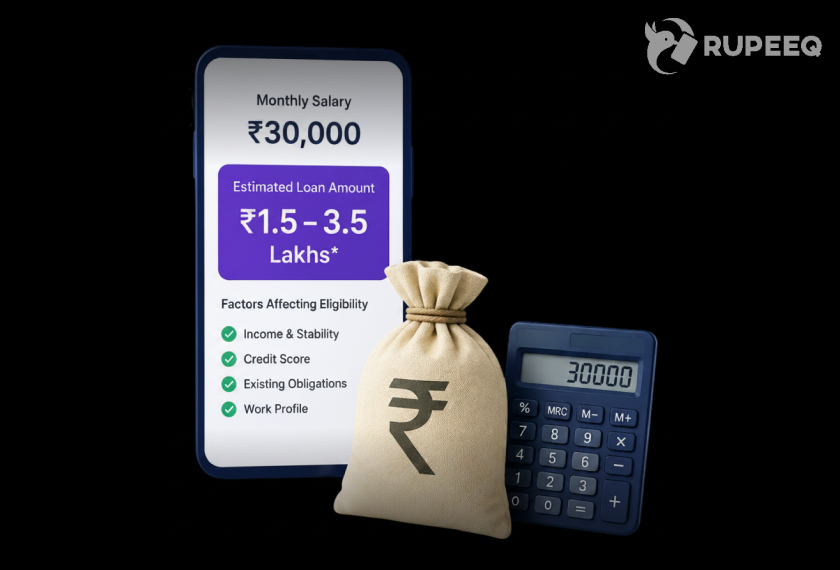
Lenders calculate your eligible amount as a multiple of your net monthly salary, adjusted for what you already owe.
- Most lenders offer 10 to 24 times your net monthly salary
- On ₹30,000, that typically works out to ₹3 lakh to ₹7.2 lakh
- Your FOIR (Fixed Obligation to Income Ratio) usually needs to stay under 50%
- Any active EMIs or credit card dues reduce the final number
If you’re already paying off a ₹6,000 EMI, that eats directly into what a new lender is willing to sanction.
Worked Example: FOIR and Loan Eligibility
Here’s how a lender actually arrives at your number, using a ₹30,000 salary with one existing EMI:
| Step | Calculation | Amount |
| Monthly salary | — | ₹30,000 |
| Max FOIR allowed (50%) | 50% × ₹30,000 | ₹15,000 |
| Existing EMI | — | − ₹6,000 |
| Available EMI capacity | ₹15,000 − ₹6,000 | ₹9,000 |
| Estimated loan eligibility | ₹9,000 EMI capacity, ~15% p.a., 5-yr tenure | ~₹3,80,000 |
Clear that ₹6,000 EMI before you apply, and the same salary comfortably supports a ~₹6 lakh loan instead, nearly 60% more.
Steps to Get a Personal Loan on 30000 Salary
Getting the best offer isn’t about applying everywhere and hoping. It’s about following the right sequence.
Step 1: Work Out Your FOIR Before You Apply
Add up every EMI and minimum credit card due you’re currently paying. Divide that total by your salary. If it crosses 50%, a personal loan on 30000 salary becomes harder to get at a decent amount.
RupeeQ Tip: Use RupeeQ’s free EMI Calculator to check your FOIR and see how your eligible loan amount shifts once an existing EMI is cleared. It takes under two minutes.
Step 2: Match Yourself to the Right Lender
Not every lender treats ₹30,000 the same way. Some banks offer higher multipliers to salaried applicants with established salary accounts, while certain NBFCs cap loan amounts lower regardless of income.
- Compare at least three lenders before applying on RupeeQ.com
- Check the income multiplier each one offers at your salary level
- Avoid lenders whose processing fees eat into your sanctioned amount
RupeeQ Tip: Applying to the wrong lender adds a hard inquiry to your credit report for nothing. Comparing offers first protects your score before you even submit an application.
Step 3: Keep Your Documents Ready
At a ₹30k salary, pre-approved or no-document offers are rare, missing paperwork is one of the most common causes of delay.
| Document | Requirement |
| Identity proof | PAN card + one government photo ID |
| Address proof | Not older than three months |
| Income proof | Last three months’ salary slips |
| Bank statements | Last six months |
Full checklist: documents required for personal loans
Step 4: Check Your Credit Score
At ₹30,000, your credit score often decides whether you get the standard rate or a premium one. A score above 700 typically unlocks better terms and a higher sanctioned amount.
If your score needs work, spend a few weeks clearing credit card balances and avoiding new EMIs before you apply again.
Step 5: Apply Once, Not Everywhere
Submit your application through a single platform that matches you to lenders based on your actual profile. Multiple applications within a short window each create a hard inquiry, and that pulls your score down further with every attempt.
What Can Push Your Loan Amount Higher
A few factors can move you from a standard offer to a stronger one, even at the same salary.
- A salary account held with the lender you’re applying to
- At least one year of continuous employment at your current job
- Documented side income like freelance work or rental earnings
- A co-applicant with stable income and a clean credit history
If your own numbers fall a little short, this breakdown on how to boost loan eligibility with a low salary covers practical ways to strengthen your profile before reapplying.
Common Mistakes That Shrink Your Loan Amount
- Ignoring existing EMIs when estimating what you can borrow
- Applying to a lender whose minimum multiplier doesn’t fit ₹30,000 income
- Skipping the credit score check and applying blind
- Submitting incomplete bank statements or mismatched address proof
- Comparing offers after applying instead of before
Final Thought
A personal loan on 30000 salary isn’t a stretch for most lenders. It’s a bracket where banks and NBFCs are actively competing for your business. The amount you walk away with depends on your FOIR, your credit score, and how carefully you pick the lender.
If you want a clearer starting point, it helps to understand personal loan eligibility in India before you submit anything.
Compare matched offers on RupeeQ.com and find lenders that actually fit your ₹30,000 salary, without wasting a hard inquiry on the wrong one.
FAQs
-
What is the maximum personal loan I can get on a ₹30,000 salary?
Most lenders offer between ₹3 lakh and ₹7.2 lakh, depending on your FOIR, credit score, and the lender’s income multiplier.
-
Can I get a personal loan on 30000 salary with a low credit score?
It’s possible with select NBFCs, but the loan amount will likely be smaller and the interest rate higher than what a strong credit score would get you.
-
Does a co-applicant increase my loan amount at this income level?
Yes, if they have a stable income and a good credit history. Their earnings get added to yours during eligibility calculation.
-
How much EMI can I afford on a ₹30,000 salary?
Keeping your FOIR under 50% generally means a total EMI outgo of around ₹15,000 a month, including any existing loans.
-
Do banks or NBFCs offer better terms at ₹30,000 salary?
Banks often offer lower interest rates, while NBFCs tend to approve faster with lighter documentation. Comparing both before applying gives you the clearer picture.