Your credit card bill says ₹2.5 lakhs, Car loan says ₹5 lakhs and we haven’t even talked about the BNPL EMI’s. The interest rate is 15-35% per year. And every month, despite paying EMIs, the balance barely moves.
Sound familiar?
This is exactly where most people start exploring debt consolidation. Two options come up immediately: take a fresh personal loan to clear the debt, or do a balance transfer to another lender at a lower rate.
Both can reduce your interest burden. But one gives you far more control, speed, and flexibility than the other.
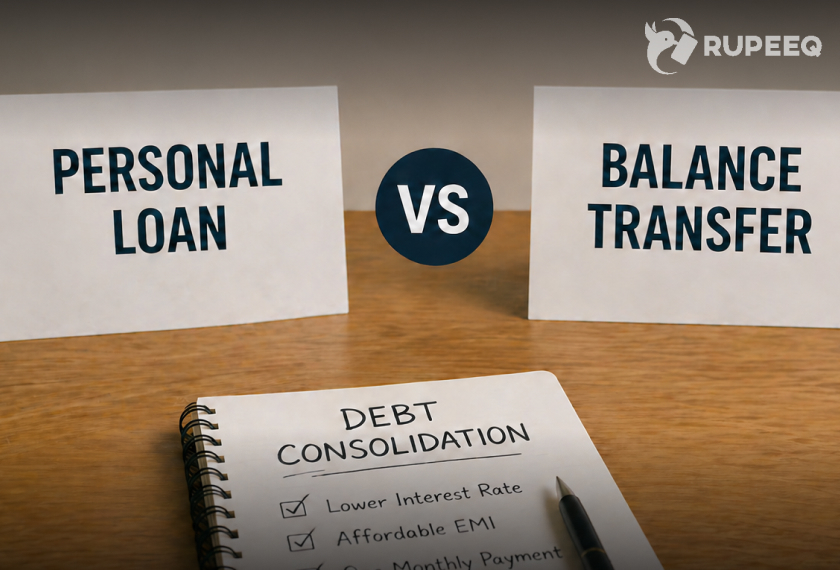
Here’s a clear breakdown of personal loan vs balance transfer so you can pick the option that actually works for your situation.
What Is a Balance Transfer?
A balance transfer means moving your existing loan or credit card debt to a new lender at a lower interest rate. You do not get new money. You just shift your debt to a cheaper lender.
Key features:
- Works for credit card debt, home loans, and existing personal loans
- The new lender pays off your old lender directly
- You repay the new lender at a lower rate
- Processing fees and foreclosure charges apply
The catch? You can only transfer one debt at a time, and the process takes longer than most people expect.
What Is a Personal Loan for Debt Consolidation?
A personal loan for debt consolidation means borrowing a fresh lump sum to pay off multiple existing debts like credit cards, personal loans, and buy-now-pay-later dues together in one shot. You close all old accounts and repay a single loan at a fixed EMI.
Key features:
- Unsecured loan, no collateral needed
- Can consolidate credit cards, personal loans, and buy-now-pay-later dues together
- Fixed interest rate and fixed EMI for the entire tenure
- Approved based on income and CIBIL score, often within hours
Personal Loan vs Balance Transfer: Quick Comparison
| Feature | Personal Loan | Balance Transfer |
| Loan Type | Unsecured | Varies by lender |
| Best For | Multiple debts, full consolidation | Single high-rate debt |
| Interest Rate | 10.5% to 24% p.a. | 9% to 18% p.a. |
| Processing Fee | 1% to 3% | 0.5% to 2% |
| Approval Time | Minutes to 24 hours | 3 to 7 days |
| CIBIL Score Required | 650 and above | 700 and above |
| Prepayment Charges | May apply | May apply |
| Debt Coverage | Multiple debts at once | One debt at a time |
| Usage Flexibility | High | Limited to debt transfer |
Real Cost Comparison: Same Debt, Two Options
According to the Reserve Bank of India, outstanding credit card dues alone in India crossed ₹2.91 lakh crore (India Today). Think about how much higher other loans, like gold loans and home loans, might have crossed.
That makes the cost of staying stuck in high-interest debt very real.
Let’s say you have ₹1,50,000 outstanding at 42% annual interest.
Option 1: Personal Loan at 13% for 3 years
| Detail | Amount |
| Loan Amount | ₹1,50,000 |
| Interest Rate | 13% p.a. |
| Tenure | 36 months |
| Monthly EMI | ₹5,051 |
| Total Interest Paid | ₹31,836 |
| Processing Fee (2%) | ₹3,000 |
| Net Total Cost | ₹34,836 |
Option 2: Balance Transfer at 11% for 3 years
| Detail | Amount |
| Outstanding Amount | ₹1,50,000 |
| Interest Rate | 11% p.a. |
| Tenure | 36 months |
| Monthly EMI | ₹4,913 |
| Total Interest Paid | ₹26,868 |
| Processing Fee (1.5%) | ₹2,250 |
| Foreclosure Charges on Old Loan (3%) | ₹4,500 |
| Net Total Cost | ₹33,618 |
The balance transfer saves roughly ₹1,218 over three years. That is barely ₹34 per month. And that assumes you qualify for 11%, have zero missed payments, and your old lender charges only 3% for foreclosure.
In most real cases, those conditions do not all line up together.
RupeeQ Tip: Use RupeeQ’s free EMI calculator to run this comparison for your exact loan amount. The difference in total cost often surprises people once fees are factored in.
Eligibility: Where Personal Loans Have an Edge
Let’s learn how personal loans are better options than balance transfer.
Balance Transfer Eligibility
- Minimum 12 EMIs already paid on the existing loan
- No missed or delayed payments in the last 6 to 12 months
- CIBIL score of 700 and above
- New lender evaluates your complete repayment history
Personal Loan Eligibility
- Age: 21 to 60 years
- Monthly income: ₹15,000 and above
- CIBIL score of 700 and above
- Salaried or self-employed with 1+ year of work history
The personal loan bar is more straightforward. A balance transfer gets rejected the moment you have even one or two delayed payments on record, even if your current finances are stable.
A personal loan lender looks at your overall profile, not just your repayment history on one specific account.
RupeeQ Tip: Check your free credit score on RupeeQ ACE before applying. If your score is above 700, you are likely to qualify for personal loan rates starting from 10.5%, which makes the cost gap with balance transfer even smaller.
Hidden Costs That Make Balance Transfer Less Attractive
The advertised rate on a balance transfer looks great. But here is what quietly adds up:
Balance Transfer hidden costs:
- Foreclosure charges on the old loan: 2% to 5% of outstanding
- Processing fee on new loan: 0.5% to 2%
- Legal or administrative charges for secured loans
- Stamp duty in some states
- If the transfer gets delayed, you keep paying the old high rate
Personal Loan hidden costs:
- Processing fee: 1% to 3%
- Prepayment penalty after lock-in: 2% to 5%
- GST on processing fees
The personal loan has fewer moving parts. You know the total cost upfront with no dependency on your old lender’s cooperation or timeline.
Which Is Better for Debt Consolidation?
| Your Situation | Better Option |
| Multiple debts from different lenders | Personal Loan |
| One large loan above 18% interest | Balance Transfer |
| Any delayed payments in last 12 months | Personal Loan |
| Want approval within 24 hours | Personal Loan |
| Self-employed or irregular income | Personal Loan |
| Foreclosure charges above 3% on old loan | Personal Loan |
| Clean record and rate drop above 5% | Balance Transfer |
| Want simpler process with fewer conditions | Personal Loan |
In most everyday debt situations, a personal loan is the more practical choice. A balance transfer wins only when the numbers work out cleanly, which requires a very specific set of conditions to be true at the same time.
Conclusion
Debt consolidation is a smart move. But the tool you use matters more than the intention behind it.
The bottom line on personal loan vs balance transfer is this: if your financial situation is clean, your old loan rate is extremely high, and the numbers work out after all fees, a balance transfer can save you money.
But if you want a reliable, flexible, and faster path out of debt, a personal loan is the more practical choice for most people.
Compare your options on RupeeQ.com and choose the loan that costs you less in total, not just on paper.
Frequently Asked Questions
-
Is a personal loan better than a balance transfer for debt consolidation?
For most borrowers, yes. A personal loan consolidates multiple debts at once, approves faster, and has fewer conditions. A balance transfer is only clearly better when the rate drop is significant and your repayment record is spotless.
-
Will a balance transfer affect my CIBIL score?
Yes, temporarily. The new lender does a hard inquiry, which may drop your score by a few points. Timely repayment after the transfer helps recover it.
-
Can I take a personal loan if I already have an existing personal loan?
Yes, as long as your income supports the total EMI obligations and your CIBIL score meets the lender’s requirement.
-
Can I use a personal loan to pay off credit card debt?
Yes. This is one of the most common uses. Credit cards charge 36% to 48% annually. A personal loan at 13% to 15% saves a significant amount over the same period.
-
What is the minimum outstanding for a balance transfer?
Most lenders require a minimum outstanding of ₹10,000 to ₹25,000 to process a balance transfer.