You checked your score, it looked decent, you applied for a loan, and still got rejected. That kind of confusion almost always traces back to one of the many credit score myths that borrowers carry around without ever questioning.
These myths are not harmless. They lead to bad decisions, rejected applications, and lost time trying to fix the wrong things.
Here are the ones that still mislead the most borrowers, and what is actually true.
Myth 1: Checking Your Own Credit Score Hurts It
This one has been floating around for years and it is completely false.
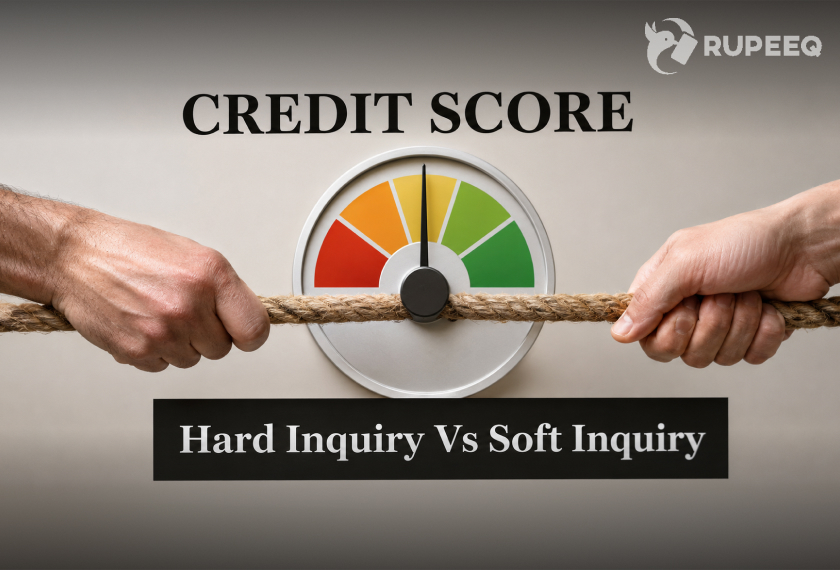
When you check your own score, it is a soft inquiry. Soft inquiries and hard inquiries are two different things. Soft ones do not affect your credit score at all. The confusion comes from mixing this up with hard inquiries, which lenders trigger when you formally apply for credit.
- Soft inquiry: You check your score, a lender pre-screens you – no impact
- Hard inquiry: You submit a loan or credit card application – small, temporary dip
Checking your score regularly is actually recommended. It helps you catch errors, track progress, and know where you stand before approaching a lender.
RupeeQ Tip: Check your credit score for free on RupeeQ ACE anytime without worrying about score impact. It is a soft check and gives you a clear picture of your credit profile.
Myth 2: A High Income Automatically Means a High Credit Score
Your salary does not appear anywhere on your credit report. Lenders do use income while assessing loan eligibility, but your credit score itself is built entirely on how you handle credit, not how much you earn.
Someone earning ₹80,000 a month with multiple missed payments and high credit utilization can easily have a lower score than someone earning ₹25,000 who pays every bill on time.
What actually builds your score:
- Payment history (the biggest factor)
- Credit utilization ratio
- Length of credit history
- Types of credit accounts
- Number of recent hard inquiries
Income influences loan approval, but it does not move your score one point in either direction.
Myth 3: Closing Old Credit Cards Improves Your Score
This feels logical. Fewer cards, less risk. But it tends to work the other way.
When you close an old credit card, two things happen that can hurt your score:
- Your total available credit decreases, which pushes your utilization ratio up
- Your credit history length may shorten, especially if it was one of your oldest accounts
According to some reports, Credit utilization (30%) and Payment history (35%) together account for 65% of a CIBIL score. Closing a card with a high limit and no balance removes available credit without removing any debt, which is the opposite of what you want.
If a card has no annual fee, keeping it open and occasionally using it for small purchases keeps it active and preserves your utilization ratio.
Myth 4: You Only Have One Credit Score
Most borrowers assume there is a single number that defines their credit health. In reality, there are four credit bureaus in India:
- CIBIL (TransUnion)
- Experian
- Equifax
- CRIF High Mark
Each bureau calculates scores using its own model, and lenders may pull your report from any one of them. Your scores across bureaus can differ because not all lenders report to all four, and the timing of data updates varies.
This is why checking your score on one platform and assuming it matches what a lender sees is not always accurate. It is worth understanding how your CRIF credit score differs from other bureaus before you apply for credit, since different lenders use different bureau reports.
Myth 5: Paying Off a Loan Early Always Improves Your Score
Personal loan prepayment feels like a win, and financially it often is. But the credit score impact is not always positive.
When you close a loan account early:
- The active account is removed from your credit mix
- Your credit history may thin out if you had few other accounts
- Lenders lose visibility into your ongoing repayment behavior
This does not mean you should avoid prepaying. If you are saving on interest, the financial benefit usually outweighs any temporary score movement. But expecting a score jump immediately after prepayment is one of the more common credit score myths borrowers hold.
Myth 6: A Good Score Guarantees Loan Approval
A score above 750 certainly improves your chances, but approval is never automatic. Lenders look at several other factors alongside your score:
- Your Debt to Income Ratio
- Job stability and employment type
- The lender’s internal risk policies
- How recently you applied for other loans
- The specific loan type and amount
A borrower with a 780 score but a debt to income ratio already at 55% can still get rejected for a new loan. Therefore, a good credit score still does not guarantee loan approval.
RupeeQ Tip: Before applying, use the free EMI Calculator on RupeeQ to check your current debt to income and understand exactly how much new EMI your income can absorb without triggering a rejection.
Myth 7: Your Score Recovers Quickly After a Missed Payment
One missed EMI or late payment can knock your score down significantly, and the recovery takes far longer than most people expect.
Payment history is the single largest component of your credit score. A single 30-day late payment can stay on your credit report for up to seven years, and while its impact fades over time, it does not disappear fast.
The score drop happens quickly. The recovery requires months of consistent on-time payments to start showing meaningful improvement. This is one of the more painful credit score myths because people realize too late that damage is much easier to cause than reverse.
Steps that actually help recovery:
- Pay every current bill and EMI on time, without exception
- Bring down credit card balances to under 30% of the limit
- Avoid applying for new credit during the recovery period
- Dispute any errors on your report that are not accurately reflecting your history
Understanding how late payments impact your credit score in detail can help you prioritize the right actions first.
Myth 8: No Credit Is Better Than Bad Credit
Having zero credit history might seem safe, but lenders see it differently. With no credit footprint, they have no way to assess your repayment behavior. That uncertainty can lead to rejections or higher interest rates, even if your finances are otherwise solid.
A thin credit file is often treated with the same caution as a weak credit file.
If you are starting from scratch, a secured credit card or a small credit builder loan are among the most effective ways to establish a positive credit history without taking on unnecessary risk.
The Bigger Picture
Most of these credit score myths persist because the underlying system is not transparent enough for most borrowers to fully understand without effort.
Scores move for reasons that are not immediately obvious, and the gap between what borrowers assume and how bureaus actually calculate things is wide.
The practical takeaway is simple: focus on what actually moves your score. Pay on time, keep utilization low, check credit score on RupeeQ.com, avoid multiple loan applications in a short window, and check your report regularly for errors. Everything else is noise.
FAQs
-
Does checking my credit score every month lower it?
No. Checking your own score is a soft inquiry and has zero impact on your credit profile. Only hard inquiries from lenders, triggered when you formally apply for credit, can cause a small, temporary dip.
-
Can I have a high credit score even with a low salary?
Yes. Your salary is not part of your credit report. A person earning ₹20,000 a month with a clean repayment history can have a higher score than someone earning ₹60,000 with frequent missed payments.
-
How long does a missed payment stay on my credit report?
A late or missed payment can remain on your credit report for up to seven years. Its impact on your score fades over time, but it does not disappear quickly. Consistent on-time payments after the miss are the fastest way to begin recovery.
-
Will closing a credit card I don’t use anymore improve my score?
Usually not. Closing a card reduces your total available credit and can shorten your credit history length, both of which can pull your score down. If the card has no annual fee, keeping it open and occasionally active is the better move.
-
Is a 750 credit score enough to guarantee loan approval?
No. A score of 750 improves your eligibility significantly, but lenders also evaluate your FOIR, employment stability, existing debt, and internal risk policies. Two borrowers with the same score can receive very different decisions depending on these factors.
Disclaimer: Credit scores and loan approval criteria vary across lenders and bureaus. This article is for informational purposes only. Always verify terms and eligibility with the lender before applying.