Most car buyers assume the loan with the lower interest rate is automatically the better one. That assumption costs people money every day.
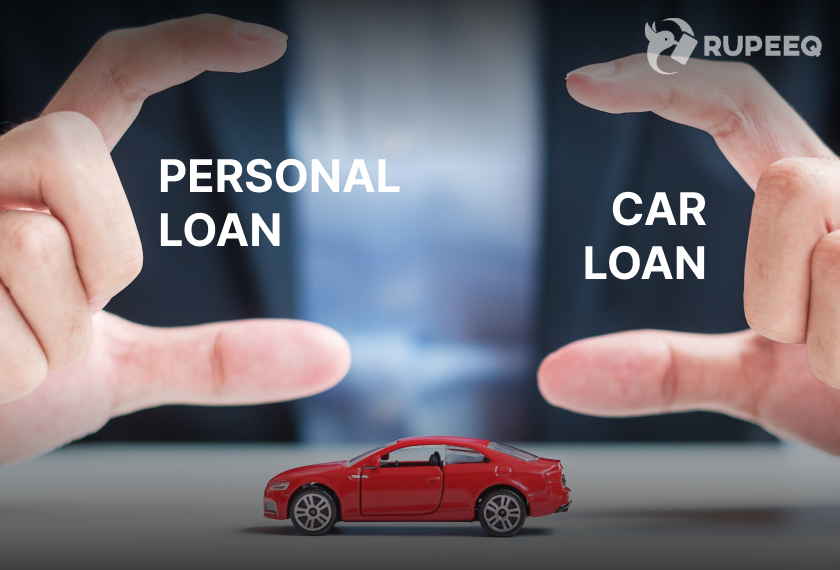
The Personal Loan vs Car Loan choice depends less on the headline rate and more on which car you are buying, and who you are buying it from.
Here is how the two actually compare.
Personal Loan vs Car Loan: What Actually Separates Them
The difference is not just the interest rate. It is what the lender holds while you repay.
- A car loan is secured. The car is hypothecated to the lender until your last EMI clears
- A Personal Loan is unsecured, so nothing is pledged and the RC stays clean
- Car loan money goes straight to the dealer. Personal Loan money lands in your account
- Car loans restrict end use to the vehicle. A Personal Loan has no such restriction
- Car loans run around 8% to 11% a year. Personal Loans typically start near 11%
That gap exists because of risk, and it is the same logic that separates secured and unsecured Personal Loans in every other category.
RupeeQ Tip: Ask every lender whether the quoted rate is flat or reducing balance before you compare anything. Dealers often quote flat rates that look cheaper than they are. Understanding flat rate vs reducing rate can change which offer actually wins.
Personal Loan vs Car Loan: The Full Comparison
Vehicle borrowing is not cooling off. RBI data for September 2026 shows credit to the personal loans segment grew 17.3% year on year, with vehicle loans among the segments that stayed resilient (Source: Reserve Bank of India). More competition between lenders means more room for you to negotiate.
| Factor | Car Loan | Personal Loan |
| Type | Secured against the car | Unsecured, no collateral |
| Interest rate | Around 8% to 11% p.a. | Around 11% to 24% p.a. |
| Funding | Up to 85% to 100% of on-road price | Based on income and credit profile |
| Tenure | Up to 7 years | Usually up to 5 years |
| End use | Vehicle purchase only | No restriction |
| RC status | Hypothecated to the lender | Clean, in your name |
| Disbursal | Paid to the dealer | Credited to your account |
| Approval time | 2 to 7 days, valuation included | Often 24 to 48 hours |
| Vehicle age limit | Yes, 8 to 10 years at maturity | None |
On the unsecured side, your sanctioned amount comes down to income, FOIR, and credit score, which is what Personal Loan eligibility in India is built on.
What the Rate Gap Costs on a Real Car
Numbers make this clearer than any argument.
Take an ₹8 lakh loan over five years:
- At 9% a year, the EMI is roughly ₹16,606 and total interest is about ₹1.96 lakh
- At 14% a year, the EMI is roughly ₹18,615 and total interest is about ₹3.17 lakh
- The difference is around ₹2,000 a month and ₹1.2 lakh over the full term
That is the real price of picking the unsecured route when a car loan was available to you. On a smaller ticket of ₹2 lakh, the same rate gap costs far less in rupees, which is why small borrowings rarely justify the extra paperwork of a secured loan.
Tenure matters just as much, because loan tenure impacts EMI and total interest in opposite directions.
RupeeQ Tip: Run both scenarios on RupeeQ’s free EMI Calculator before you sign anything. Enter the amount, both rates, and both tenures. Two minutes there will tell you exactly how much the convenience of an unsecured loan is costing you.
Personal Loan vs Car Loan: 5 Buying Situations, Decided
Generic comparisons do not help once you are at the showroom. These five situations cover almost every real car purchase in India.
Dealerships are built for car loans. The lender pays the showroom directly, and funding can reach 85% to 100% of the on-road price. Rates sit at the lowest end because brand new collateral carries the least risk. Choosing an unsecured loan here costs more for no added benefit.
Key features: Rates from roughly 8% a year, tenure up to 7 years, high loan-to-value, direct disbursal to the dealer, easy pre-approved offers for salaried buyers.
Best for: First-time buyers and anyone buying a new car through a registered dealer.
-
Buying a used car under five years old
Banks still treat this as a clean secured deal. The car holds resale value and comes with a proper invoice, so a used car loan goes through. Rates run one to three percentage points above new car rates. Loan-to-value also drops, so keep more cash ready for the margin.
Key features: Rates roughly 10% to 15% a year, LTV around 70% to 85% of assessed value, tenure capped by the car’s age, mandatory valuation report.
Best for: Buyers picking a certified pre-owned car with verified papers and a single previous owner.
-
Buying a car older than eight years or from a private seller
This is where the car loan quietly disappears. Most lenders will not finance a vehicle crossing 8 to 10 years at loan maturity. A private sale with no dealer invoice is equally hard to fund. A Personal Loan has no end-use condition, so the seller gets paid directly and the deal closes.
Key features: No collateral, no vehicle valuation, no age limit on the car, amount based purely on your profile, funds credited to your account.
Best for: Older cars, informal sales between individuals, and any deal a bank refuses to touch. You can apply for a Personal Loan online and close the purchase the same week.
-
Covering registration, insurance, and accessories
Car loans fund the car, not everything attached to it. Insurance, registration, extended warranty, and accessories usually sit outside the sanctioned amount. On a mid-range car, that gap can cross a lakh. A smaller unsecured loan covers it without disturbing your car loan structure.
Key features: Smaller ticket size, faster approval, light paperwork, tenure of 12 to 36 months, no impact on the car loan sanction.
Best for: Buyers with the down payment arranged but short on on-road extras. Keep the documents required for Personal Loans ready to speed this up.
-
Planning to resell the car within two or three years
A hypothecated car is harder to sell. You need the loan closed, an NOC from the lender, and hypothecation removed from the RC at the RTO. That process adds weeks to a resale. An unsecured loan keeps the RC clean from day one.
Key features: No hypothecation entry, no lender NOC at resale, full ownership immediately, higher interest cost as the trade-off.
Best for: Buyers who change cars often or expect to sell before the loan would normally close.
Where Borrowers Go Wrong
The decision usually fails on execution, not logic.
- Comparing a dealer’s flat rate against a bank’s reducing balance rate
- Accepting in-house dealer finance without pulling a single outside quote
- Stretching tenure to seven years only to shrink the EMI
- Ignoring processing fees, documentation charges, and hypothecation costs
- Forgetting existing EMIs, which push FOIR past the 50% limit most lenders use
- Applying to four lenders in one week, which is why many Personal Loan applications get rejected
Lenders price each applicant separately, which is why Personal Loan interest rates vary so widely between two people buying the same car.
Compare Before You Commit
Checking offers one lender at a time wastes time and adds hard inquiries you did not need.
RupeeQ.com matches you with Personal Loan offers from leading NBFCs based on your actual profile. The RupeeQ app keeps your credit score, the EMI Calculator, and your matched offers in one place, so you can check eligibility before you walk into a showroom.
Download the RupeeQ app and compare your options in a few minutes.
Final Thought
For a new car from a dealer, the car loan wins on cost almost every time. For an older car, a private sale, or the expenses sitting around the purchase, the unsecured route is often the only one that works.
So the Personal Loan vs Car Loan answer is not fixed. It changes with the car, the seller, and how long you plan to keep it. Decide that first, then compare offers.
FAQs
-
Can I get a car loan if I already have a Personal Loan running?
Yes, provided your total EMIs stay within the lender’s FOIR limit, usually 50% of net income. Your existing EMI reduces the car loan amount you qualify for.
-
Will the lender seize my car if I default on a Personal Loan?
No. A Personal Loan is unsecured, so the car is not pledged against it. The lender can still pursue legal recovery and report the default to credit bureaus.
-
Is prepayment cheaper on a car loan or a Personal Loan?
Floating rate car loans usually allow free prepayment for individual borrowers. Most Personal Loans carry foreclosure charges of 2% to 5%, often after a lock-in of six EMIs.
-
Does a car loan affect my credit score differently?
Both report to bureaus the same way. A secured car loan adds variety to your credit mix, which can support your score slightly more across a full repayment cycle.
-
Can I switch from a Personal Loan to a car loan later?
Not directly, since the car is already registered in your name without hypothecation. You can apply for a loan against the car, then use it to close the existing loan.
Disclaimer: Interest rates, processing fees, repayment terms, and loan eligibility criteria may vary depending on the lender, applicant profile, RBI guidelines, and market conditions. The information shared in this article is for general informational purposes only and may change over time. Always verify the latest terms and charges before applying.