Your salary hits on the 1st. A car repair bill lands on the 28th. That eight-day gap can quietly derail your month if you don’t have the right financial tool ready.
This is exactly the problem an Overdraft facility for salaried employees is built to solve. It’s not a loan you apply for in a panic. It’s a pre-approved credit buffer that sits in your account and activates only when you need it.
What Is an Overdraft Facility for Salaried Employees?
An Overdraft (OD) facility lets you withdraw more than your account balance, up to a pre-set limit. You pay interest only on the amount you use, not the entire sanctioned limit.
Unlike a Personal Loan, there’s no fixed tenure or EMI schedule. You draw when you need, repay when you can, and the interest accrues daily on the outstanding balance.
For salaried employees specifically, most banks tie the OD limit to your net monthly salary, typically between 1x to 3x your take-home pay.
How It’s Different from a Personal Loan
People often confuse the two. Here’s the core difference:
- Personal Loan: Personal Loan is a lump sum credited to your account, repaid in fixed EMIs over a set term
- Overdraft: Overdraft or Flexi Loan is a revolving credit line you dip into and repay flexibly, with interest only on what you use
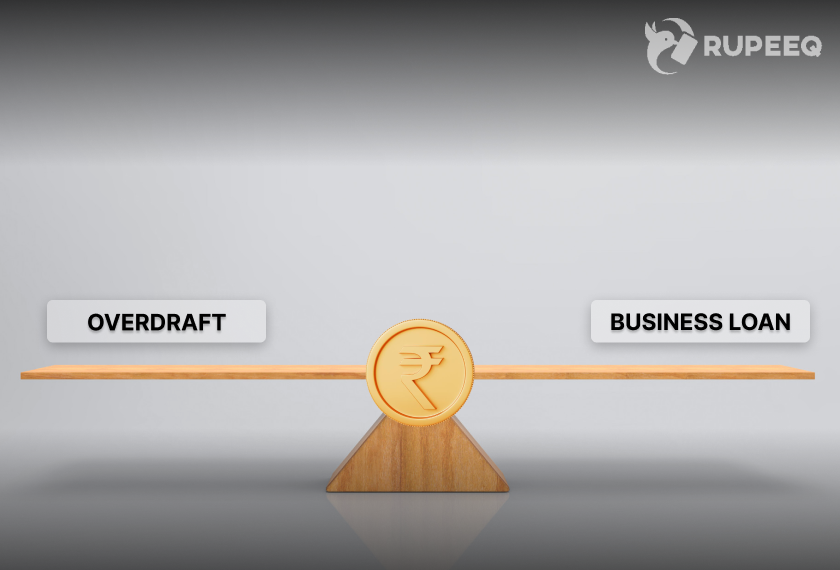
If you need ₹2 lakh for a one-time expense and will repay it steadily over two years, a Personal Loan makes more sense. If you need ₹30,000 this week and expect to repay it by next month’s salary, an Overdraft costs you far less.
RupeeQ Tip: Not sure whether a Personal Loan or an Overdraft works out cheaper for your specific need? Use the free EMI Calculator on RupeeQ to compare the actual repayment cost before you decide.
Who Is Eligible for an Overdraft Facility?
Eligibility criteria vary slightly across banks and NBFCs, but here’s what most lenders look at:
- Employment type: Salaried employees with a stable job, usually with at least 6-12 months of continuous service
- Salary account: Most banks offer OD only if your salary is credited to an account with them
- Minimum salary: Typically ₹15,000-₹25,000 per month, depending on the lender
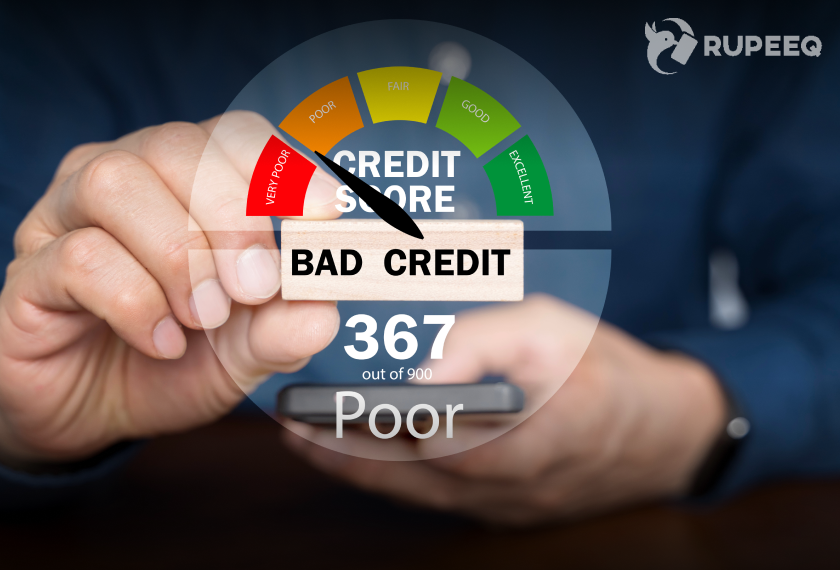
- Credit score: A score of 700 or above significantly improves your chances and the limit you get
- Existing debt: Lenders check your Fixed Obligation to Income Ratio (FOIR) before approving the limit
According to data from TransUnion CIBIL, borrowers with a credit score above 750 are nearly 3x more likely to get credit products approved compared to those below 650.
Therefore, check your free credit score on RupeeQ ACE before approaching any lender. A score above 700 always puts you in a better position to negotiate the interest rate on your Overdraft
How to Apply for an Overdraft Facility as a Salaried Employee
Managing short-term cash flow gaps becomes much easier when you have access to an Overdraft facility. Before applying, however, it is important to understand how the process works, what banks evaluate, and how to improve your approval chances.
Step 1: Check Your Eligibility First
Log in to your bank’s net banking portal or mobile app. Most major banks (SBI, HDFC, ICICI, Axis, Kotak) show pre-approved OD offers if your salary account qualifies. If an offer is pre-approved, you won’t need to submit fresh documents.
Step 2: Review the Limit and Interest Rate
The sanctioned limit and applicable interest rate are shown upfront. OD interest rates for salaried employees typically range between 10.5% to 18% per annum, depending on your credit profile and the lender.
Do not accept the first offer you see. Compare across lenders if possible.
RupeeQ Tip: Instead of checking multiple lenders individually, compare Overdraft offers, interest rates, and eligibility criteria across providers in one place at RupeeQ.com.
Step 3: Submit the Required Documents
For most pre-approved OD offers, documentation is minimal:
- Valid photo ID (Aadhaar, PAN)
- Last 3-6 months’ bank statements (salary account)
- Salary slips for the last 3 months
- Employment letter or offer letter (some banks ask for this)
If you’re applying fresh at a bank where your salary isn’t credited, you’ll also need address proof and Form 16.
Step 4: Accept the Terms and Activate the Facility
Once the limit is sanctioned, the OD is linked to your account. In most digital banks, activation happens within 24 hours. You can withdraw up to the limit via net banking, UPI, or ATM, just like a regular balance.
Step 5: Use It and Repay Strategically
This is the step most people skip planning for. Interest on Overdraft compounds daily. If you draw ₹20,000 and leave it unpaid for 30 days at 14% per annum, the interest works out to roughly ₹230.
Repay as soon as your salary is credited. Partial repayments reduce the outstanding balance and cut the interest cost immediately.
When Does an Overdraft Facility Make Sense?
An Overdraft facility for salaried employees is most useful in specific situations:
- Month-end cash crunches: When your salary is a week away and an urgent expense can’t wait
- Utility bill payments or rent: To avoid penalties or delays on fixed obligations
- Short-term medical expenses: Smaller hospital bills or medicines that need quick payment
- Unexpected travel costs: Emergency trips where you need funds within hours
It’s not a substitute for a Personal Loan for larger, planned expenses. An Overdraft used for a ₹3 lakh wedding expense and left unpaid for six months will cost significantly more in interest than a term loan would have.
Mistakes to Avoid With an Overdraft Facility
- Using it as regular income: An Overdraft is a safety net, not a salary extension
- Letting the balance roll over for months: Daily compounding adds up faster than most people expect
- Ignoring the credit score impact: Frequent high utilization of your OD limit can signal credit stress to bureaus
- Not tracking usage: Unlike EMIs, there’s no fixed reminder. It’s easy to forget what you owe
How Multiple Credit Products Affect Your Profile
Using an Overdraft responsibly is actually positive for your credit profile. It demonstrates that you can manage revolving credit without defaulting. However, drawing close to your full limit regularly, or missing repayments, works against you in the same way that maxed-out credit cards affect your credit score.
The key is to keep the average utilization of your OD under 30-40% of the sanctioned limit.
Overdraft vs. Personal Loan: Quick Comparison
| Feature | Overdraft Facility | Personal Loan |
| Disbursement | Instant (pre-approved) | 1-3 business days |
| Interest charged on | Amount used, daily | Full loan amount, monthly |
| Repayment | Flexible | Fixed EMIs |
| Best for | Short gaps, urgent needs | Large planned expenses |
| Tenure | Revolving | Fixed (12-60 months) |
Final Word
An Overdraft facility for salaried employees is one of the most underused tools in personal finance. Done right, it costs less than a Personal Loan for short-term needs, activates instantly, and doesn’t lock you into a fixed repayment schedule.
The key is using it with a clear repayment plan. Without that, what starts as a ₹15,000 drawdown in November can quietly turn into a running balance by March.
Check whether your salary account already has a pre-approved OD offer waiting for you. Most salaried employees don’t know it’s there until they look.
FAQs
-
Can I get an Overdraft facility if my salary is below ₹20,000?
Yes. Some NBFCs and smaller banks offer OD limits starting from lower salary thresholds. However, the sanctioned limit will be proportionally smaller, and your credit score will carry more weight in the approval decision.
-
Does using an Overdraft hurt my credit score?
Not if you use it within your limit and repay on time. High utilization or missed repayments can negatively affect your score, similar to how credit card debt impacts your credit profile.
-
Is the interest rate on an Overdraft fixed or variable?
It depends on the lender. Many banks offer floating rates on Overdraft facilities, which means the rate can change with market conditions. Always confirm whether the rate is fixed or linked to an external benchmark.
-
What happens if I don’t repay the Overdraft balance for a long time?
The bank will charge daily interest on the outstanding amount. If the balance remains unpaid beyond a certain period, the bank may reduce or withdraw your OD limit and report the delinquency to credit bureaus.
-
Can I increase my Overdraft limit later?
Yes. Most banks review OD limits periodically based on your salary growth, credit score, and repayment behavior. You can also request a limit enhancement by submitting updated salary documents.
Disclaimer: Interest rates, processing fees, repayment terms, and loan eligibility criteria may vary depending on the lender, applicant profile, RBI guidelines, and market conditions. The information shared in this article is for general informational purposes only and may change over time. Always verify the latest terms and charges before applying.