You walk into your bank, your account balance is zero, and a payment is due today. Instead of a rejection, your bank lets the transaction go through anyway.
That is an Overdraft facility at work, and it is one of the most misunderstood credit products in India.
An Overdraft loan in India works differently from a Personal Loan, yet most borrowers have never been told exactly how, or when it actually makes sense to use one.
What Is an Overdraft Loan?
An Overdraft Loan (OD) is a credit facility where a bank or NBFC sets a pre-approved limit on your account. You can withdraw beyond your available balance, up to that limit. You pay interest only on the amount you use, not the entire sanctioned limit.
Unlike a Personal Loan where you receive a lump sum and pay EMIs from day one, an Overdraft works more like a revolving credit line. You draw when you need to, repay when you can, and the limit resets.
According to the Reserve Bank of India, banks in India collected nearly ₹11,500 crore in Overdraft fees during FY 2021-22, highlighting how widely Overdraft facilities are used for short-term liquidity.
How Does an Overdraft Loan Work in India?
Here is a straightforward breakdown of how the facility actually functions:
- Sanctioned limit: The bank approves a maximum borrowing limit based on your income, collateral, or account history.
- Usage: You can withdraw any amount up to this limit as and when needed.
- Interest calculation: Interest is charged daily on the outstanding balance, not on the full limit.
- Repayment: There is no fixed EMI structure. You repay as funds flow into your account.
- Limit renewal: Most OD accounts are reviewed and renewed annually.
So if your Overdraft limit is ₹2 lakh and you use only ₹40,000 for 10 days, you pay interest on ₹40,000 for those 10 days only.
RupeeQ Tip: Not sure whether an Overdraft or a Personal Loan works out cheaper for your situation? Use RupeeQ’s free EMI Calculator to compare your actual cost before committing.
Types of Overdraft Facilities Available in India
Not all Overdraft facilities work the same way. Some are backed by assets like fixed deposits or property, while others are approved based on your income, banking history, or credit profile.
Understanding the different types helps you choose an option that matches both your borrowing need and repayment capacity.
1. Secured Overdraft
This is backed by collateral. Common forms include:
- Overdraft against fixed deposit (FD)
- Overdraft against property
- Overdraft against life insurance policy
- Overdraft against shares or mutual funds
Since the bank holds security, the interest rate is lower, usually between 1% to 2% above your FD rate in the case of FD-backed OD.
2. Unsecured Overdraft
This is offered based on your income, credit profile, or salary account history. Banks often extend this to:
- Salaried customers with a long account relationship
- Self-employed professionals with stable business income
- Current account holders with high average balances
Interest rates here are higher, typically ranging from 12% to 18% per annum depending on the lender.
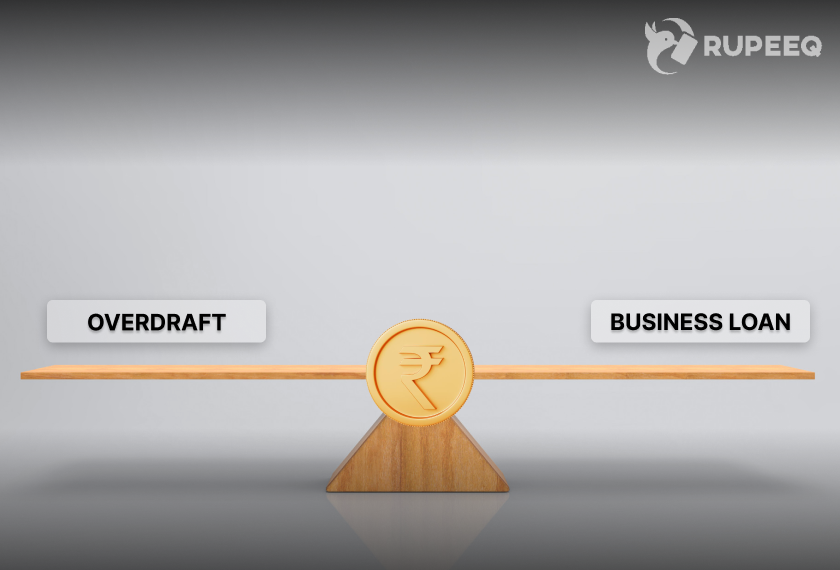
Overdraft Loan vs Personal Loan: Key Differences
This is where most borrowers get confused. Here is a clear comparison:
| Feature | Overdraft Loan | Personal Loan |
| Disbursement | Revolving limit | One-time lump sum |
| Interest | Only on amount used | On full loan amount |
| Repayment | Flexible, no fixed EMI | Fixed monthly EMIs |
| Usage | Multiple drawdowns | Single use |
| Processing | Usually faster for existing customers | Standard verification process |
| Best for | Short-term, recurring cash needs | One-time large expenses |
If you need funds for a specific goal like a medical procedure, wedding, or home renovation, a Personal Loan gives you structure and predictability. If you are managing working capital or bridging a short cash gap, an Overdraft offers flexibility.
Many salaried borrowers who qualify for Personal Loans find that understanding their Debt-to-income ratio before applying makes a significant difference in the amount they can borrow.
Who Is Eligible for an Overdraft Loan in India?
Eligibility varies across lenders, but here are the common criteria:
For salaried individuals:
- Minimum monthly salary of ₹15,000 to ₹25,000 (varies by bank)
- Salary account maintained with the lender for 6 to 12 months
- CIBIL score of 650 or above preferred
For self-employed individuals:
- Minimum 2 years of business continuity
- ITR filings for at least 2 years
- Steady bank account turnover
For secured OD:
- A qualifying asset such as an FD, property, or LIC policy
RupeeQ Tip: Your credit score plays a direct role in the Overdraft limit a lender will offer. Check your credit score for free on RupeeQ ACE before approaching any lender, so you know exactly where you stand.
How to Apply for an Overdraft Loan in India
Applying for an Overdraft facility is usually simpler than most borrowers expect, especially if you already have a salary or current account with the lender. The exact process varies between banks and NBFCs, but the core steps remain largely the same.
Step 1: Choose the Right Type
Decide whether you want a secured or unsecured Overdraft. If you have an FD, starting with a secured OD is usually faster and cheaper.
Step 2: Check Your Eligibility
Review the lender’s income and credit requirements. For unsecured OD, your credit history carries significant weight.
Step 3: Gather Your Documents
Standard documents typically include:
- Identity proof (Aadhaar, PAN)
- Address proof
- Last 3 to 6 months’ bank statements
- Salary slips or ITR (depending on employment type)
- For secured OD: asset documents (FD receipt, property papers)
Getting these right upfront avoids delays. A clean document checklist reduces back-and-forth with the lender considerably.
Step 4: Submit the Application
You can apply online through your bank’s net banking portal or visit a branch. Many banks offer pre-approved OD limits to existing salary account holders through their apps.
Step 5: Await Approval and Limit Activation
Once approved, the limit is activated on your account. You can start drawing funds immediately.
When Does an Overdraft Make Sense?
An Overdraft loan in India works well in specific situations:
- Temporary cash shortfall before your salary credit date
- Business working capital gaps between receivables and payables
- Emergency expenses where the duration of borrowing is short and unpredictable
- Active FD holders who do not want to break their deposit prematurely
It does not work well for large, long-term borrowing needs. In those cases, a Personal Loan with fixed tenure gives you a clearer repayment plan and often a lower effective cost.
Conclusion
An Overdraft loan in India is a flexible borrowing tool, but it is not a one-size-fits-all solution. Used for short, specific cash needs, it is cost-effective and convenient. Used as an ongoing crutch, it can get expensive fast.
Before choosing between an Overdraft and a Personal Loan, assess how long you actually need the funds and how certain you are about repayment timing. That single consideration usually makes the right product obvious.
Still unsure whether an Overdraft or Personal Loan is the smarter option for your situation? Compare loan options, check eligibility, and calculate your repayment costs easily on RupeeQ.com before making a borrowing decision.
FAQs
-
Is an Overdraft loan the same as a Personal Loan?
No. An Overdraft is a revolving credit facility where interest is charged only on what you use. A Personal Loan gives you a fixed amount at once with structured EMIs.
-
What is the interest rate on an Overdraft loan in India?
Secured ODs (against FD) typically charge 1% to 2% above the FD rate. Unsecured ODs range from 12% to 18% per annum, depending on the lender and your credit profile.
-
Does an Overdraft affect my credit score?
Yes. High utilization of your Overdraft limit, missed interest payments, or defaults will negatively impact your CIBIL or CRIF score.
-
Can I get an Overdraft without a salary account with the bank?
It is possible but less common. Most banks prefer existing relationship customers for unsecured OD. Secured Overdrafts are more accessible regardless of your account history.
-
What happens if I do not repay the Overdraft amount?
Interest keeps accumulating, and the lender may reduce or cancel your limit. Continued non-payment gets reported to credit bureaus and affects your borrowing ability significantly.