Running your own business or practice means your income rarely flows on a fixed date. One month it’s great. The next, a client delays payment and suddenly you’re staring at an expense you can’t defer.
Most self-employed professionals in that spot reach for a Personal Loan. But there’s a better tool sitting right inside your bank account, and most people ignore it entirely.
An overdraft for self-employed professionals is built for exactly this kind of situation: variable income, irregular cash flow, and credit needs that don’t always come with a fixed price tag.
Why a Personal Loan Often Doesn’t Fit Self-Employed Cash Flow
India’s workforce is majority self-employed. According to the Periodic Labour Force Survey by MOSPI, over 55% of workers run their own business or practice rather than drawing a fixed salary. Yet most financial products, including Personal Loans, are still built around the assumption of a monthly paycheck.
That mismatch is exactly why an overdraft for self-employed professionals deserves more attention than it gets.
A Personal Loan gives you a lump sum upfront. For self-employed professionals, it often creates the opposite problem:
- You’re paying interest on money you haven’t deployed yet, or your repayment date collides with a slow billing month.
An overdraft loan works differently. You get a credit limit linked to your current or savings account. You draw only when you need to, repay when cash comes in, and pay interest only on what you’ve used and only for the days you’ve used it.
That structure fits a consultant, freelancer, or business owner far more naturally than a fixed EMI schedule.
RupeeQ Tip: Before applying for an overdraft, check your credit score for free on RupeeQ ACE. Lenders offering overdraft facilities to self-employed applicants weigh credit scores heavily because there’s no fixed salary as a backstop.
How Overdraft for Self-Employed Professionals Actually Works
Here’s what the structure looks like in practice:
- Approved limit: Bank or NBFC sets a credit ceiling based on your income proof, turnover, and credit profile
- Drawdown: You withdraw as much or as little as you need, within that limit
- Interest: Interest is calculated daily and charged only on the drawn amount
- Repayment: No fixed EMI. You repay as your cash flow allows, typically within the billing cycle or quarter
- Revolving access: Once you repay, the limit is restored and available again
This revolving structure is what makes overdraft for self-employed professionals fundamentally more flexible than a Personal Loan.
RupeeQ Tip: Use the free EMI Calculator on RupeeQ to understand what your monthly outgo would look like if you convert a portion of your overdraft balance into a structured repayment. It helps you plan before you draw.
Eligibility: What Banks and NBFCs Look For
Lenders don’t apply a single template, but most require the following for self-employed applicants:
- Business vintage: Minimum 2 to 3 years of continuous operations
- Income proof: Last 2 years’ ITR with computation, audited financials for higher limits
- Bank statements: Typically the last 12 months to assess average monthly balance and cash inflows
- Credit score: 700 and above improves your chances significantly; below 650 limits options
- Business type: Proprietary firms, partnerships, freelancers, and professionals like doctors and CAs are all eligible with most banks
- Turnover: Higher annual turnover usually unlocks higher limits
Some lenders also accept GST returns and Form 26AS as supporting income documents, particularly for applicants whose ITR doesn’t fully reflect their actual business earnings.
Documents You’ll Need to Apply
Getting the paperwork in order upfront speeds up the process:
- PAN card (mandatory in all cases)
- Aadhaar or other government-issued address proof
- Last 2 years’ ITR with computation sheets
- Latest audited balance sheet and P&L (if applicable)
- Last 12 months’ bank statements
- GST registration certificate or trade license
- Business proof such as a shop establishment certificate or professional certificate
How the Overdraft Limit Is Calculated
Most banks use a combination of three factors:
- Average monthly bank balance: A higher average monthly balance signals repayment discipline
- Annual net income or turnover: The limit is often set at a multiple of monthly net income
- Credit history and existing obligations: Outstanding loans reduce your available limit
Limits for self-employed professionals typically range from ₹2 lakh to ₹50 lakh, depending on the lender, business size, and creditworthiness. Public sector banks tend to be conservative; private banks and NBFCs often approve higher limits with faster processing.
Steps to Apply for an Overdraft as a Self-Employed Professional
Step 1: Pick the Right Lender
Your existing bank is the easiest starting point. If your salary or business account sits with a bank, they already have your transaction history. That reduces documentation and often speeds up approval.
If you want to compare options, platforms like RupeeQ.com show you overdraft and credit line offers from multiple lenders without triggering multiple hard inquiries on your credit report.
Step 2: Prepare Your Financial Documents
Gather the ITR, bank statements, and business proof before you apply. Gaps in documentation are the most common reason for delays with self-employed applications.
Step 3: Submit the Application
Most banks now offer online overdraft applications for existing account holders. New-to-bank applicants usually need to visit a branch or submit documents digitally through the bank’s portal.
Step 4: Assessment and Limit Sanction
The bank reviews your credit profile, income documentation, and account behavior. For existing account holders, this can take 2 to 5 working days. New applicants may wait slightly longer.
Step 5: Activation
Once sanctioned, the overdraft limit is linked to your account. You can draw against it immediately. The interest clock starts only when you withdraw.
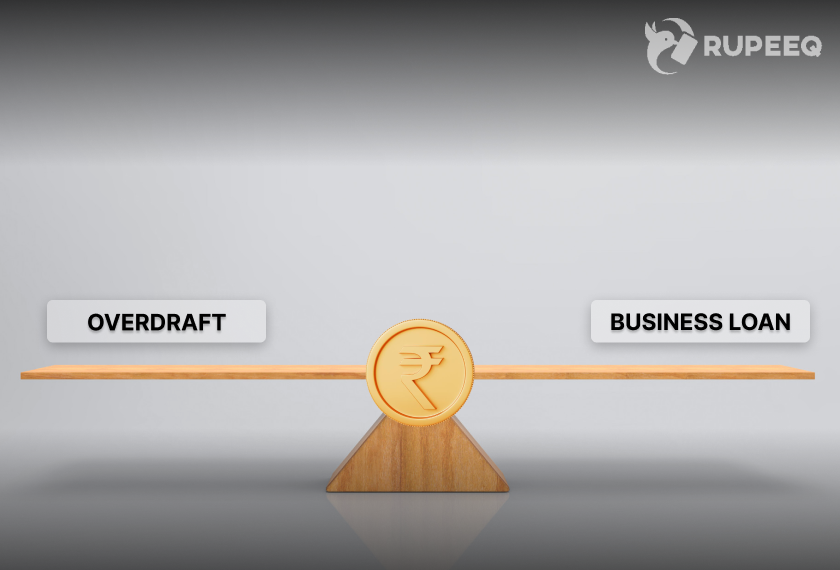
Overdraft vs. Personal Loan: The Real Comparison
| Factor | Overdraft | Personal Loan |
| Interest charged on | Amount drawn, daily | Full loan amount from day one |
| Repayment | Flexible, no fixed EMI | Fixed monthly EMI |
| Access | Revolving, reusable | One-time disbursement |
| Best for | Short-term and irregular needs | Planned, one-time large expense |
| Processing | Faster for existing customers | Slightly longer |
For a self-employed professional managing uneven cash inflows, the overdraft wins on almost every practical dimension for short-term needs. If you need a large amount for a specific purpose, say renovating your office or buying equipment, a Personal Loan still makes more sense.
What to Watch Out For
A few things can quickly turn an overdraft from a useful tool into a debt trap:
- Letting the balance roll over: Interest compounds if you don’t repay the drawn amount regularly. Aim to clear at least the interest portion every month.
- Treating it as extra income: The limit is credit, not free cash. Overuse can push your credit utilization up and affect your credit score in the same way high credit card usage does.
- Applying to multiple banks at once: Each application triggers a hard inquiry. Multiple inquiries in a short window signal credit-hungry behavior to lenders.
- Ignoring renewal deadlines: Most overdraft facilities are reviewed annually. If your financials have weakened, the bank may reduce or withdraw the limit at renewal.
Quick Summary
Overdraft for self-employed professionals works when:
- Your income arrives in irregular cycles
- You need a buffer, not a large one-time amount
- You want to avoid fixed EMI pressure during slow months
- You expect to repay quickly once payments come in
It doesn’t work as well when:
- You need a large, defined amount for a planned expense
- You struggle to repay even informally without a structured EMI
- Your credit score is below 700 and lenders are likely to offer a very low limit
If you’ve been defaulting to Personal Loans for every cash crunch, it’s worth exploring whether an overdraft fits your actual borrowing pattern better. For many self-employed professionals, it does.
FAQs
-
Can a freelancer with no registered business get an overdraft?
Yes, though options are more limited. Some banks and NBFCs offer overdraft or credit line products based on ITR and bank statement analysis, without requiring formal business registration.
-
Does an overdraft show up on my credit report?
Yes. The sanctioned limit and utilization are reported to credit bureaus. High utilization can affect your credit score, similar to a credit card.
-
What if my ITR shows lower income than my actual earnings?
Your approved limit will reflect the income shown in your ITR. Lenders can only assess what’s documented. This is one reason accurate ITR filings matter for self-employed applicants beyond just tax compliance.
-
Can I convert my overdraft balance into a Personal Loan later?
Some banks allow you to convert a drawn overdraft balance into a term loan with fixed EMIs. This is useful if you’ve drawn a large amount and want a repayment structure. Check with your lender whether this option is available.