An Overdraft rarely feels expensive when you take it. The cost reveals itself later, in small increments that are easy to overlook but hard to reverse.
What makes it tricky is not the rate itself, but the way interest is calculated. Unlike a standard loan, where the structure is fixed and predictable, an Overdraft shifts with your behavior. The amount you use, the timing of your repayments, even short gaps between transactions all influence the final cost.
Banks do not calculate interest on the total limit you are approved for. They apply it to the amount that remains outstanding at the end of each day. The Reserve Bank of India formalizes this approach for Overdraft and cash credit facilities, where interest is computed on daily balances rather than sanctioned limits.
This changes how borrowing works in practice. Two people with the same Overdraft limit and the same interest rate can end up paying very different amounts, depending on how they use the facility.
So when we ask, how is interest calculated on an Overdraft Loan, we are really asking how time, usage, and balance interact. The answer sits in those daily movements, not in a fixed schedule or a simple percentage.
The Key Principle Behind Overdraft Interest
An Overdraft does not come with a fixed repayment path, so the interest has nothing fixed to attach itself to. It follows the balance as it changes.
On any given day, there is a single number that matters: what remains outstanding in the account. That figure becomes the basis for interest. If the balance is higher tomorrow, the interest reflects that. If it drops, the cost adjusts with it.
This is why Overdraft Loans tend to feel inexpensive at first and then gradually become harder to track. There is no single moment where the cost becomes visible. It builds quietly, shaped by how long the money stays in use and how often the balance is brought down.
Over time, patterns start to matter more than individual transactions. An account that carries a balance for most of the month will accumulate far more interest than one where funds move in and out quickly, even if both use similar amounts.
Nothing about the calculation is hidden. It is simply tied very closely to behavior, which is where most of the variation comes from.
How is Interest Calculated on an Overdraft Loan
The easiest way to understand this is to follow the money as it moves. An Overdraft doesn’t sit still, and neither does the interest. It builds in small, daily increments, shaped entirely by how long your balance stays elevated.
Step 1: Start with what you’ve actually used
Say your approved limit is ₹10 lakh. You withdraw ₹3 lakh.
From that moment, interest begins on ₹3 lakh. The unused ₹7 lakh stays irrelevant unless you draw from it.
A few days later, you repay ₹1 lakh. Your outstanding drops to ₹2 lakh, and the interest adjusts from that day onward. There’s no lag, no recalculation window. The change is immediate.
This is where many borrowers slip. They think in terms of limits, while the bank is looking only at usage.
RupeeQ Tip: If you have incoming cash flows, even partial repayments can make a difference. You don’t need to wait to clear the full amount. Reducing the balance early directly lowers your interest.
Step 2: Break the annual rate into something meaningful
Let’s take a common rate: 12% per annum.
On its own, that number doesn’t tell you much. What matters is how it translates daily:
- Daily rate: 12% ÷ 365 = 0.0329%
It’s a small fraction, which is why Overdrafts feel inexpensive in the short term. The cost becomes visible only when that daily charge runs for longer than expected.
Step 3: Watch how interest builds across days
Now let’s put this into a real sequence:
- Day 1–5: ₹3,00,000 outstanding
- Day 6–10: ₹2,00,000 outstanding
For the first five days: ₹3,00,000 × 0.0329% = ₹98.7 per day
Total = ₹493
For the next five days: ₹2,00,000 × 0.0329% = ₹65.8 per day
Total = ₹329
Total interest over 10 days: ₹822
Nothing here is averaged. Each day is calculated on its own terms, then added up.
RupeeQ Tip: Tools like RupeeQ ACE can help you track utilisation patterns instead of just outstanding amounts. When you see how long funds stay deployed, it becomes easier to spot where interest is quietly adding up
Step 4: Timing changes more than most people expect
Now shift just one variable.
Instead of repaying ₹1 lakh on Day 5, you delay it to Day 10.
- Day 1–10: ₹3,00,000 outstanding
- Day 11–15: ₹2,00,000 outstanding
You’ve held a higher balance for five extra days. The rate hasn’t changed. The limit hasn’t changed. Yet the interest increases simply because the repayment came later.
This is where Overdrafts become expensive without looking expensive. There’s no single large charge, just small daily additions that compound over time.
RupeeQ Tip: Treat idle balances as a cost, not a cushion. If funds are sitting unused in your account while your Overdraft is active, you are effectively paying interest unnecessarily.
Step 5: What the final interest amount really reflects
By the end of the billing cycle, the bank adds up each day’s interest. That total is what you see charged.
There is no flat formula applied to the entire period. The final number is simply a reflection of your behavior across days:
- how much you used
- how long you held it
- how quickly you reduced it
Once you see that pattern, the question of how is interest calculated on an Overdraft Loan becomes less abstract. It’s not just a formula. It’s a running calculation that mirrors every decision you make with that credit line.
What Impacts the Interest You Pay
By this point, the calculation itself is clear. What’s less obvious is why the final number varies so much from one borrower to another, even when the rate looks similar on paper.
The difference comes from a few moving parts that don’t always get the attention they deserve.
The Interest Rate You’re Offered
Not all Overdrafts are priced the same. The rate depends on your profile, your relationship with the lender, and in many cases, whether the facility is secured.
A difference of even 1–2% may not seem significant, but when applied daily over a fluctuating balance, it adds up faster than expected. Borrowers often focus on access to funds and overlook how much that rate influences long-term usage.
RupeeQ Tip: Don’t treat the first offer as fixed. If your cash flows are stable or backed by assets, there’s usually room to negotiate a better rate
How Long Does the Balance Stay in Use
Duration does more work than most people realize.
Two businesses might both use ₹5 lakh. One clears it in 7 days, the other in 25. The second borrower pays substantially more, even though the amount and rate are identical.
This is where Overdrafts quietly shift from short-term support to a longer-term cost
How Often You Bring The Balance Down
It’s not just about full repayment. Frequency matters.
If your account sees regular inflows that reduce the outstanding balance, even temporarily, your interest drops during those periods. If the balance stays consistently high, interest builds without interruption.
Over time, this creates a visible gap between borrowers who actively manage the account and those who let it run.
RupeeQ Tip: Route incoming payments through the Overdraft account when possible. Even short-lived reductions in balance can lower your total interest outgo.
How Your Usage is Spread Out
Lump-sum withdrawals and staggered usage behave very differently.
If you withdraw a large amount upfront and hold it, interest starts accumulating immediately on the full balance. If you draw smaller amounts as needed, the exposure stays lower for longer.
The total amount used might be the same. The cost rarely is.
Changes in Floating Rates
If your Overdraft is linked to a floating benchmark, the rate itself can move during your usage period.
These changes are not always dramatic, but over longer cycles, they can influence the total interest charged. Many borrowers miss this because they focus only on their initial sanction terms.
Common Misunderstandings About Overdraft Interest
Most of the confusion around Overdrafts doesn’t come from complex math. It comes from assumptions carried over from other types of loans.
Interest is charged on the full limit
This is the most persistent one. If you’re approved for ₹10 lakh but only use ₹2 lakh, interest applies only to ₹2 lakh. The unused portion does not attract interest.
Where people go wrong is mentally treating the limit as a lump sum loan. It isn’t. The limit is just a ceiling. The cost begins only when you draw from it.
It’s calculated monthly, like other loans
Overdraft interest doesn’t wait for the end of the month. It is calculated daily, based on the closing balance. What you see at the end of the month is simply the total of those daily calculations.
This distinction matters because timing starts to influence cost. A repayment made on the 5th of the month versus the 25th does not get averaged out. It directly reduces the number of days interest is applied.
If I don’t use it much, the cost will be negligible
Low usage doesn’t always mean low cost. A smaller amount held for a longer duration can end up costing more than a larger amount used briefly. The duration often does more damage than the size of the withdrawal.
This is why some Overdrafts feel inexpensive initially and then slowly become expensive without any obvious trigger.
There are no real repayment pressures
Technically, Overdrafts don’t come with fixed EMIs. That flexibility is often mistaken for a lack of urgency.
In reality, the absence of a schedule shifts the responsibility entirely to the borrower. If the balance is not actively reduced, interest continues to build without interruption.
RupeeQ Tip: Set internal repayment checkpoints even if the lender doesn’t require them. Treat the Overdraft like a short-cycle facility, not open-ended credit.
I’ll calculate the cost at the end
By the time you look at the total, the cost is already locked in. Because interest is applied daily, it’s far more effective to track and manage usage while the balance is active. Small adjustments during the cycle have a larger impact than reviewing the final number afterward.
Conclusion
Overdraft interest comes down to three things: how much you use, how long you use it, and when you bring the balance down.
There’s no fixed schedule smoothing things out. If the balance stays high for longer, the interest rises with it. If you reduce it earlier, the cost drops immediately. Even small timing differences, a few days here or there, can change the total more than most people expect.
So when you look at how is interest calculated on an Overdraft Loan, you’re really looking at a system that responds to timing as much as it does to the rate itself. The formula stays the same, but the outcome shifts based on how the account is handled day to day.
This is also why borrowers working with platforms like RupeeQ.com tend to pay closer attention to utilisation rather than just limits. The calculation doesn’t change, but the way you manage the balance does.
That’s what makes Overdrafts useful, but also easy to mismanage. Used with regular repayments and controlled usage, the cost stays predictable. Let the balance sit for too long, and the interest builds quietly in the background.
FAQs
1. Is Overdraft interest calculated daily or monthly?
Overdraft interest is calculated daily based on the outstanding balance at the end of each day. The total is then added up and charged, usually at the end of the billing cycle.
2. Do I pay interest on the full Overdraft limit?
No, interest is charged only on the amount you actually use, not on the sanctioned limit. If you use a smaller portion of your limit, interest applies only to that amount.
3. How can I reduce the interest on my Overdraft Loan?
You can reduce interest by repaying early, making partial repayments whenever possible, and avoiding holding a high balance for long periods. Even small reductions in balance can lower your total cost.
4. What happens if I exceed my Overdraft limit?
If you go beyond your approved limit, lenders usually charge penal interest on the excess amount. This rate is higher than the standard Overdraft interest
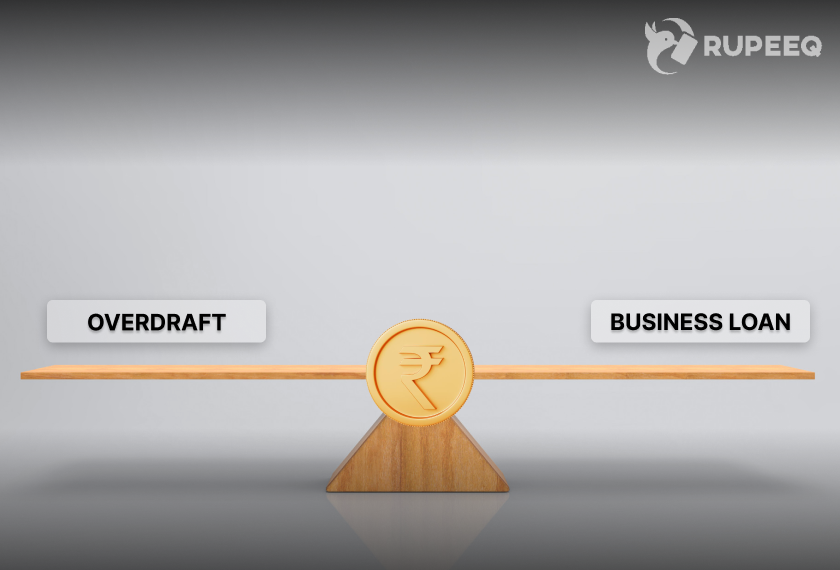
5. Is an Overdraft cheaper than a personal or business loan?
It depends on how you use it. For short-term needs with quick repayments, an Overdraft can be more cost-effective. If the balance stays outstanding for longer periods, it can become more expensive than a structured loan.