Your card gets declined at checkout. There’s ₹2,300 in the account and the bill is ₹14,800. Two options stare back at you: pay later, or dip into your Overdraft limit.
Both get you through the moment. Only one of them is actually cheap in your specific situation. Most people pick by habit instead of doing the math.
This blog breaks down the Overdraft vs BNPL decision by what each one costs, how each shows up on your credit report, and when to use which.
Overdraft vs BNPL: What You’re Actually Choosing Between
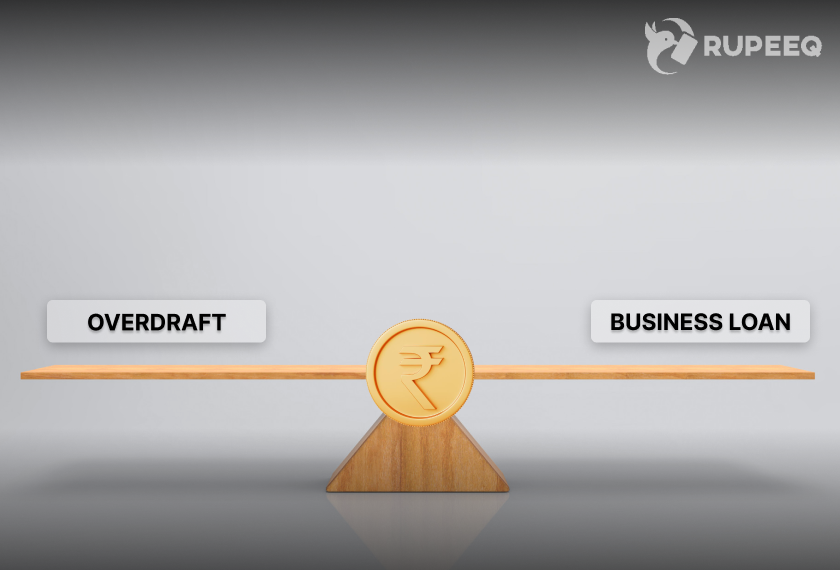
This isn’t a question of which product is better. It’s about whether you need cash in hand or a single purchase funded.
An Overdraft Gives You Cash
- A pre-approved limit linked to your savings or salary account
- Withdraw any amount up to that limit, whenever you want
- Interest applies only on what you draw, counted by the day
- Rates typically run 11% to 18% a year, depending on the bank
- No fixed EMI, so you repay whenever funds come in
The daily meter is easy to underestimate, which is why it helps to know exactly how interest is calculated on an overdraft loan before you draw.
BNPL Gives You a Purchase
- A short credit line that activates at checkout, usually ₹5,000 to ₹60,000
- A repayment window of 14 to 30 days, or 3 to 6 month EMIs
- Zero interest if you clear the full amount inside the free window
- Late fees are flat and steep, often ₹300 to ₹750 per missed cycle
- Works only where the merchant has tied up with the provider
RupeeQ Tip: Note your BNPL due date on the day you use it, not the day it falls due. Most BNPL slip-ups happen because the reminder sat inside an app nobody opened.
The ₹15,000 Test: What Each One Actually Costs
Numbers settle this faster than theory. Take the same ₹15,000 and run it through both.
- Overdraft at 14% a year, repaid in 30 days: roughly ₹172 in interest
- BNPL cleared inside the free window: ₹0
- BNPL missed by one cycle: a ₹500 late fee plus interest at 24% or higher
- Overdraft carried for 90 days instead of 30: roughly ₹515
So the Overdraft vs BNPL answer flips on one thing. Can you repay on the exact date you promised? If yes, BNPL is free. If you’re unsure, the Overdraft’s daily interest is far cheaper than a late fee stack.
RupeeQ Tip: Run both numbers through RupeeQ’s free EMI Calculator before you commit. It shows what a drawn amount costs across different tenures, so you’re comparing real rupees instead of advertised rates.
Overdraft vs BNPL: Side by Side
| Factor | Overdraft | BNPL |
| What you get | Cash in your account | A funded purchase |
| Interest charged on | Amount drawn, daily | Nothing, if repaid in the free window |
| Typical cost | 11% to 18% a year | ₹0, or 24% plus late fees after the due date |
| Where it works | Anywhere you can withdraw | Only at partner merchants |
| Repayment | Flexible, no fixed date | Fixed date, non-negotiable |
| Typical limit | 1x to 6x your monthly salary | ₹5,000 to ₹60,000 |
| Approval | One-time, stays active | Instant, per transaction |
How Each One Lands on Your Credit Report
This is the part most comparisons skip, and it’s where the two products behave very differently.
An Overdraft is reported as a revolving credit line. Drawing 90% of your limit and holding it there reads as stress, in the same way a maxed-out card does. The logic mirrors why your credit card utilization ratio matters for loans, and lenders apply the same lens to an unused OD limit.
BNPL is reported differently. Many providers now report each pay-later account as a separate small loan. Five active BNPL accounts can look like five live loans on your report, even if each one is worth ₹2,000. That’s one reason CRIF scores influence BNPL offers more tightly than they used to.
The practical takeaway on Overdraft vs BNPL: one limit used lightly looks better than six small accounts used constantly.
India’s BNPL market is expected to grow 22.5% in 2026 to reach $30.45 billion, with RBI’s digital lending rules pushing the segment toward bank-linked pay-later products. In short, BNPL is becoming more formal and more visible to lenders, not less.
Overdraft vs BNPL: Which One Fits Your Situation
-
Choose an Overdraft When You Need Cash, Not Checkout Credit
An Overdraft facility suits irregular, recurring shortfalls. Think a medical bill, a deposit, or a gap between salary credit and a big payment. You draw what you need, repay when the salary lands, and pay interest only for those days. It also doesn’t multiply into several accounts the way BNPL can.
Key features
- Interest on the drawn amount only, calculated daily
- No fixed EMI and no fixed repayment date
- Limit stays available after you repay
- Usable for cash, transfers, bills, anything
Best for: Salaried borrowers with a stable account who face short, unpredictable cash gaps every few months.
-
Choose BNPL When It’s a Single Purchase You Can Clear Fast
BNPL works best as a payment tool, not a borrowing tool. If you’re buying one item and your salary lands before the due date, the free window makes it genuinely costless. The trap is treating it as extra spending power across multiple merchants. Used that way, the fees and the report impact both pile up quietly.
Key features
- Zero interest inside the free repayment window
- Instant approval with no separate application
- Small ticket sizes, usually under ₹60,000
- Flat late fees that don’t scale down with the amount
Best for: One-off online purchases you can clear in full within 15 to 30 days.
Mistakes People Make With Both
- Running three or four BNPL accounts at once and losing track of due dates
- Treating an Overdraft limit as savings instead of borrowed money
- Converting a BNPL bill to EMI without checking the effective rate
- Holding an Overdraft balance for months because there’s no EMI pressure
- Stacking small purchases, since overuse of no-cost EMI affects your credit profile more than people expect
If you already hold an active OD, it’s worth knowing how to avoid over-borrowing with a flexi loan, because the same discipline problem applies.
Compare Before You Borrow
Short-term credit is easy to get and easy to misjudge. The RupeeQ app lets you compare Overdraft and credit line offers from leading banks and NBFCs in one place, check your credit score for free, and see matched offers based on your actual profile.
Download the RupeeQ app or visit RupeeQ.com to see what you qualify for without firing off multiple applications.
Final Thought
The Overdraft vs BNPL decision comes down to certainty. If you know the exact date your money arrives, BNPL’s free window is hard to beat. If that date is fuzzy, an Overdraft’s daily interest costs far less than a missed BNPL deadline.
Pick based on your repayment confidence, not on which button is easier to tap at checkout.
FAQs
-
Can I use both an Overdraft and BNPL at the same time?
Yes, as long as your total obligations stay within roughly 50% of your monthly income. Lenders look at the combined load, not each product separately.
-
Does BNPL show up on my credit report?
In most cases, yes. Many providers report pay-later accounts to bureaus, and several small active accounts can weigh on your score.
-
Which has a higher approval rate for first-time borrowers?
BNPL, generally. It uses smaller limits and lighter checks, while an Overdraft usually needs an established salary account relationship.
-
Is an Overdraft cheaper than converting a BNPL bill to EMI?
Usually yes. BNPL EMI conversions often carry processing fees plus interest, while an Overdraft charges only for the days you hold the amount.
Disclaimer: Interest rates, fees, repayment windows, and eligibility criteria vary by lender, applicant profile, RBI guidelines, and market conditions. The cost examples shared above are illustrative. Always verify current terms before applying.